
PARENTING • HOMESCHOOLING
What Structured Homeschooling Really Looks Like in Indian Homes (Without Burnout)
Momming with Pride • Issue 01
May 2026 • 20 min read
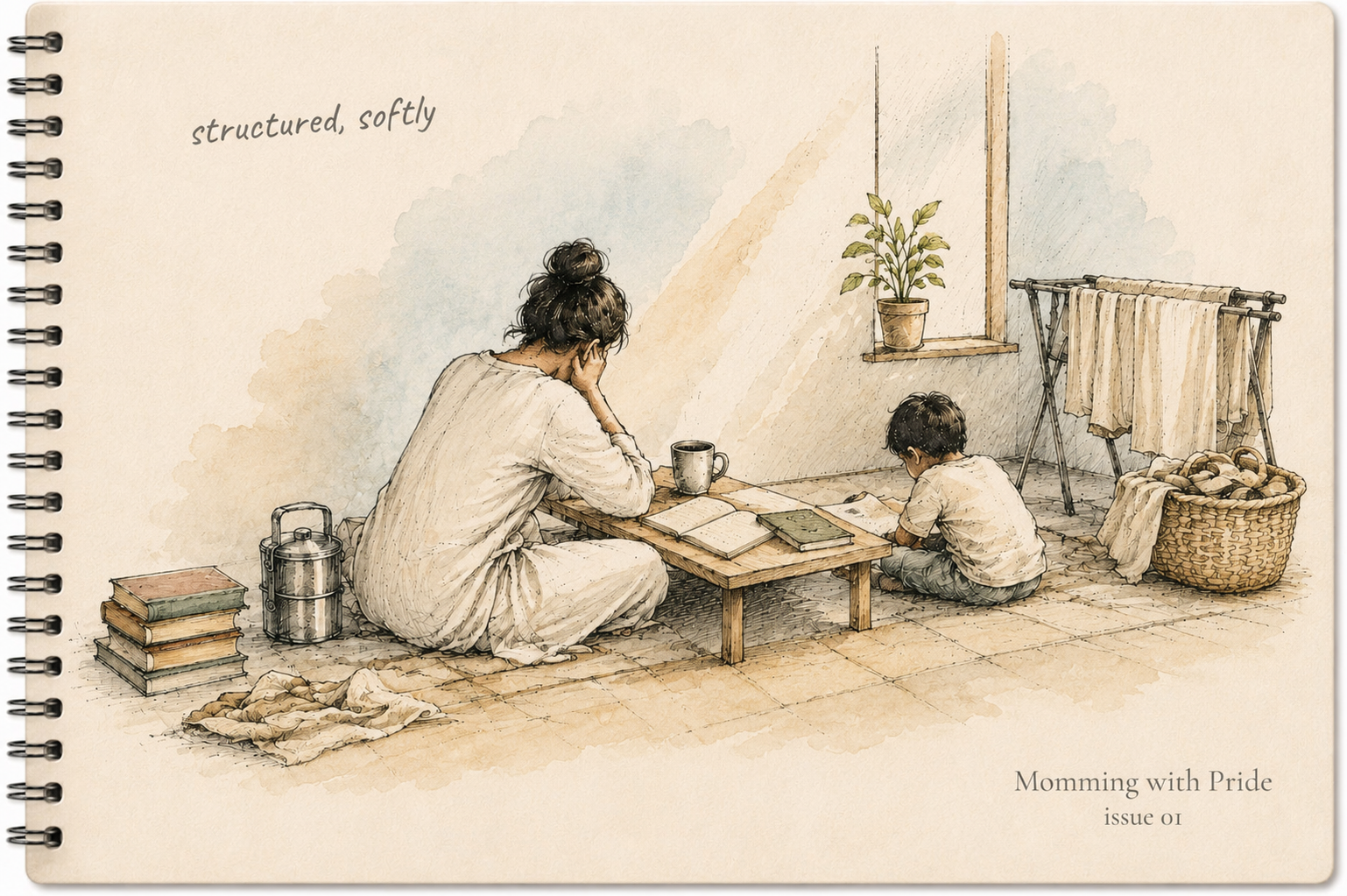
Why this post exists…
I didn’t plan to write this post as an explanation.
It came more from the number of conversations — real and imagined — that kept playing in my head.
I’ve been homeschooling my child for about a year now. And somewhere along the way, the phrase structured homeschooling started following me around. People asked about it. I questioned myself about it. And sometimes, I felt I was supposed to already have a clear answer.
What does structure even mean when learning can happen while playing, talking, reading a random board, or flipping through a paper?
Why does structure get confused with sitting at a desk for hours?
And who decides what “enough” learning looks like anyway?
This post exists because I realised many of us — especially in the Indian context — are carrying quiet confusion. We want some direction, some rhythm, some assurance. But we don’t want pressure, comparison, or a school-like setup at home.
I’ve felt the weight of being judged.
I’ve also felt the urge to prove — through portfolios, explanations, or numbers — that learning is happening.
At the same time, I’ve seen how boredom creates space. How unplanned time leads to imagination. How structure doesn’t have to mean control, and flexibility doesn’t have to mean chaos.
This isn’t a guide.
It’s not advice.
It’s simply a place to pause and reflect on what structured homeschooling can look like — when you’re still figuring it out, day by day, inside a real home, with real limits.
If you’ve ever felt unsure, defensive, or quietly thoughtful about your homeschool routine, this post is for you.
In this post, I share:
- What “structured homeschooling” actually means
- Why Indian homes need a different kind of structure
- Where burnout actually comes from
- What structured homeschooling looks like in everyday Indian homes
- Designing structure around the parent’s energy
- How structure protects relationships
- Common myths about structured homeschooling in India
What “structured homeschooling” actually means (in simple terms)
When people hear the word structure, they often imagine timetables pinned to walls.
Hourly schedules.
Strict routines.
Something that looks suspiciously like school at home.
That isn’t what it meant for us.
Structure ≠ timetable obsession
For us, structure never meant sitting at a desk for fixed hours.
It didn’t mean finishing a checklist every day.
And it definitely didn’t mean that learning had to look serious to be valid.
Learning happened while talking.
While playing.
Sometimes while reading things that had nothing to do with “children’s books.”
So when I talk about structured homeschooling, I’m not talking about controlling time.
I’m talking about creating a loose frame that holds the day together.
Structure is about predictability, not rigidity
What structure really gave my child was predictability.
She knew what learning was part of her life.
She knew where she roughly stood for her age.
She knew what her days usually included, even if the order kept changing.
That predictability mattered more than precision.
Research in child and family studies shows that predictable family routines are linked with better emotional regulation and fewer behavioural struggles in children.
Not because routines are strict — but because they reduce uncertainty.
They help children feel oriented and safe.
When a child knows what is happening in their life, they spend less energy worrying about why.
Structure begins with the parent, not the child
What surprised me most was how much structure helped me.
Without some framework, every day felt like a hundred tiny decisions.
What to do next.
What to skip.
What was “enough.”
Sociological research links unpredictable schedules with higher parental strain and mental load. That resonated deeply.
Once we had a loose structure, the noise reduced.
I wasn’t deciding everything from scratch every morning.
And when I felt steadier, my child usually did too.
This is just how it looked in our home.
It may look very different in another.
But for me, structured homeschooling slowly stopped meaning restriction — and started meaning relief.
From my homeschooling notebook
Structure is not about controlling the child.
It’s about freeing the parent from constant doubt.
Why Indian homes need a different kind of structure
When I first started reading about structured homeschooling, much of what I found didn’t quite fit our reality. Not because it was wrong. But because Indian homes work differently. Our days don’t look the same. Our spaces don’t look the same. Our pressures definitely don’t feel the same.
Homes with shared spaces and shared expectations
In many Indian homes, learning doesn’t happen in quiet, dedicated rooms. It happens in shared spaces. Living rooms. Dining tables. Corners that keep changing. Sometimes with grandparents around. Sometimes with household help moving in and out. Sometimes with relatives visiting unannounced.
Even in nuclear families, quiet and uninterrupted time is not always realistic. And honestly, that’s normal here. Over time, I realised structure didn’t need silence to survive. It just needed familiarity. A rhythm my child could recognise, even when the surroundings kept shifting.
The weight of academic expectations
Academics carry a lot of emotional weight in India. Marks. Grades. “What standard is she in?” “What is she studying?” “Is she keeping up?” These questions come early. And they don’t stop. Sometimes they’re gentle. Sometimes they’re not.
As a parent, you’re not just holding your child’s learning. You’re also holding explanations. To relatives. To neighbours. To well-meaning elders. Even when no one is directly questioning you, the awareness is there. That background noise matters.
Structure helped me here in an unexpected way. Not as something to show others — but as something to hold for myself. When I knew where we were headed, the noise outside felt less destabilising.
The constant comparison loop
Indian childhoods are deeply social. Comparison is part of everyday life here. Children notice it. Adults often reinforce it, unintentionally. Sometimes casually. Sometimes constantly.
I realised that if my child didn’t have some sense of rhythm and continuity, these comparisons could slowly create confusion or self-doubt. Not because others were right — but because children absorb tone before logic.
I found that when learning had some continuity, my child felt more secure. Not because she was ahead or behind — but because she knew where she stood in her own world. That sense of direction mattered more than explanations.
Homeschooling without a safety net
Homeschooling in India often happens without formal scaffolding. No standard pathways. No clear hand-holding. You build as you go.
That freedom can feel empowering one day, and overwhelming the next.
This is where gentle structure helped me stay anchored. Not rigid plans. Just enough clarity to return to when things felt scattered.
Indian homes are layered. Loud. Loving. Demanding. Structure, in this context, isn’t about fixing the chaos. It’s about creating a small, steady centre within it — one that both parent and child can come back to. It’s about emotional grounding. For the child. And honestly, for the parent too.
Where burnout actually comes from (and why structure isn’t the cause)
Burnout is a word that comes up often in homeschooling conversations.
And honestly, I resisted it for a long time.
It felt heavy. Dramatic, even.
But over time, I realised burnout wasn’t coming from doing too much learning.
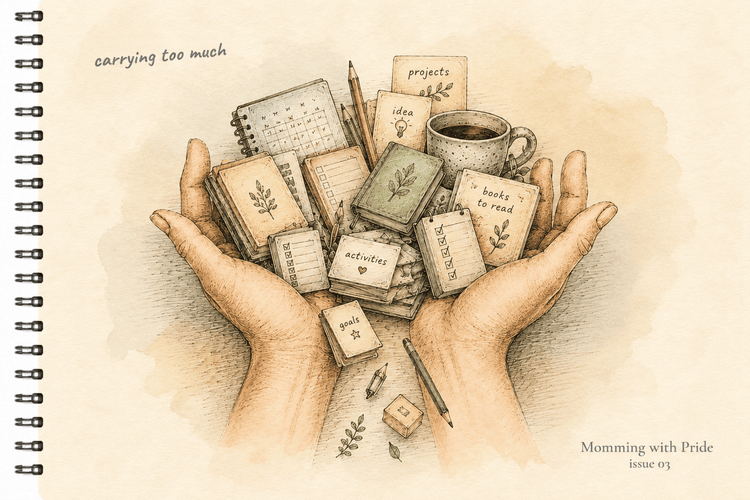
It was coming from carrying too much mental weight.
The tension between overplanning and underplanning
In the beginning, I swung between extremes. Some weeks I planned too much — researching routines, curriculums, methods. Other weeks I avoided planning altogether because I was tired of thinking.
Both felt heavy. Overplanning drained me before the week even began. Underplanning left me restless and guilty, constantly wondering if enough was happening. The stress didn’t come from structure. It came from not knowing where I was standing.
Interestingly, some discussions around parental burnout describe it as a chronic state shaped by long-term stress and emotional overload — not by the presence of routines themselves. That framing helped me breathe a little.
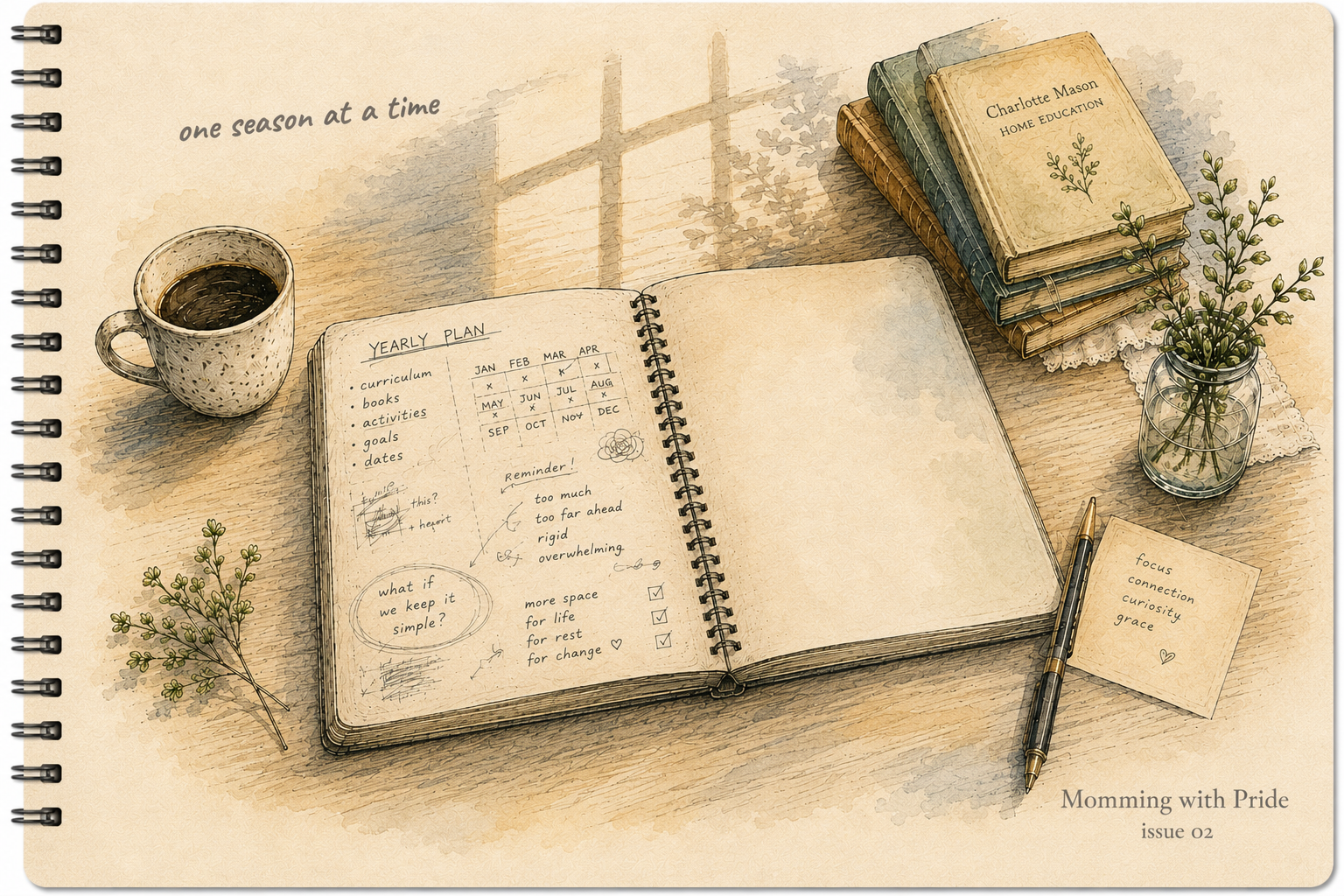
One thing that gradually reduced that pressure for me was letting go of the idea that I needed to plan an entire academic year before beginning. Over time, I found myself working in much smaller horizons instead. I wrote more about that shift in Why I Stopped Planning the Whole Year & Started Homeschooling in 12-Week Cycles.
When too many curricula compete for attention
At one point, I collected curricula like safety nets.
CBSE references here. International books there. Worksheets from everywhere.
It looked reassuring on the surface.
But inside, it created noise.
I wasn’t clear about why I was using something.
Or when it actually mattered.
Later, I understood that at this age, curriculum mattered far less than rhythm and depth.
The confusion wasn’t academic.
It was cognitive — for me.
Being the parent, teacher, and planner all at once
Homeschooling adds layers to parenting. You’re not just caring. You’re planning, tracking, deciding. Constantly.
Studies on work–family conflict show that juggling multiple roles without clear boundaries significantly increases parental burnout. I could feel that. The mental load was always running in the background.
Looking back, I can see that much of that exhaustion came from the invisible pressure I was carrying as a homeschooling parent. I wrote more about that experience in When Good Intentions Turn Heavy: The Invisible Mental Load of Homeschooling.
While these studies talk about parenting broadly — not homeschooling specifically — the pattern fits home learning spaces too.
Structure, slowly and imperfectly, reduced that load for me. Fewer daily decisions. Fewer internal debates. Not fewer challenges — but more clarity.
Burnout, I’ve learned, isn’t caused by structure. It’s caused by carrying too much uncertainty for too long.
For a moment
Ask yourself where most of your energy goes during the day.
Teaching — or managing emotions?
What structured homeschooling looks like in everyday Indian homes
When people hear the word structure, they often imagine a strict timetable pinned to the wall.
That hasn’t been my experience.
What I’ve seen, in our home at least, is something quieter.
Less visible.
More lived.
A predictable rhythm, not a daily prison
Structure, for us, showed up more as a rhythm than a schedule.
Some days are heavier.
Some are intentionally light.
There are days when learning feels active and focused, and days when it sits gently in the background.
There is room for projects.
Room for pauses.
Room for recovery.
Not every day needs to look productive to be useful.
And not every break needs to be earned.
That predictability — knowing roughly how a day flows, even if the content changes — reduced anxiety.
For my child.
And for me.
Thinking in subject buckets, not clock hours
Instead of planning hours, I began thinking in buckets.
Language shows up everywhere.
Through reading, conversations, stories before bed, even random signboards outside.
Numeracy appears while playing, counting steps, measuring ingredients, negotiating turns.
Knowledge grows through questions about surroundings, history, festivals, and daily life.
Life skills are embedded naturally — waiting, helping, managing emotions, negotiating dislikes.
Movement and play are not breaks from learning.
They are learning.
Once I stopped assigning fixed time slots, things felt lighter.
Learning didn’t need permission anymore.
Just enough structure to hold the day
Over time, I realised I didn’t need a perfect plan.
Just a minimum structure that could hold us.
There were a few non-negotiables.
Not rigid rules, but anchors.
Some things stayed flexible.
They moved around depending on energy, health, mood, and life.
And then there were optional layers — extra books, activities, ideas — that could be picked up or dropped without guilt.
This balance mattered.
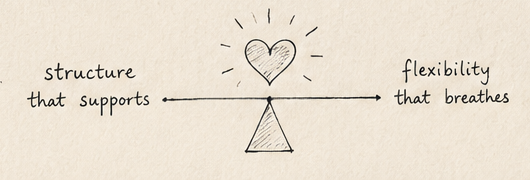
Too much rigidity created resistance.
Too much openness created restlessness.
Somewhere in between, things settled.
Structure that grows with the child
What worked when my child was younger doesn’t look the same now.
And it won’t look the same later either.
Early years needed shorter attention spans, frequent movement, and emotional regulation more than academic depth.
As we move into early primary years, the structure is slowly stretching.
Not tightening.
Just becoming clearer.
I imagine later years will bring more responsibility on her side.
More ownership.
Less dependence on me holding everything together.
Structure, ideally, should move from being external to becoming internal.
That’s the hope.
How this felt inside the home
One thing I didn’t expect was how much structure affected emotions.
Tantrums didn’t disappear.
Resistance didn’t vanish.
But they became less frequent.
Less intense.
When a child knows what to expect next, there is less negotiation.
Less fear of the unknown.
And when a parent knows where the day is headed, there is less guilt.
Less second-guessing.
This doesn’t make homeschooling easy.
It just makes it survivable.
Some days still fall apart.
Some weeks feel messy.
But now, there is a place to return to.
And that, for me, is what structured homeschooling really looks like in an Indian home.
A sample week in a structured Indian homeschool
I hesitate a little while writing this section.
Because the moment we share a “sample week,” it can start sounding like a template.
This isn’t one.
This is just a snapshot of how things often look in our home right now.
Some weeks resemble this.
Some don’t.
What stayed more or less fixed
There are a few anchors that give the day its shape.
Mornings usually begin early, with a simple routine — movement, a bit of breathing, breakfast. Nothing elaborate. Just enough to mark the start of the day.
The first learning window often happens in the morning. Short. Focused. Usually writing or something that needs more effort. Fifteen to thirty minutes is plenty at this age.
Meals, prayer time, outdoor play, and bedtime rituals stay fairly predictable.
Not clock-bound.
Just familiar.
These fixed points create a sense of “this is how our day flows,” even when the content inside changes.
What shifted from day to day
What we study is never fixed in advance for the entire week.
Some days we touch only one subject.
Some days two or three show up naturally.
Reading might happen in the afternoon one day and before bed the next.
Worksheets may appear for a few days and then disappear for a while.
Oral practice often slips into cooking time, travel, or casual conversations.
Dance class, art, free play, and outdoor time move around depending on weather, energy, and life happening around us.
There is no pressure to “balance” everything daily.
Balance happens over time.
Where flexibility showed up without things falling apart
Flexibility doesn’t mean anything goes.
If something is refused, it comes back later.
Not as a threat.
Just as a quiet return.
Free days exist.
Sometimes two or three in a row.
And then we come back.
That returning matters more than perfect consistency.
How breaks were planned (yes, planned)
There is always unplanned time built in.
Time to be bored.
Time to play alone.
Time when nothing is expected.
I’ve learnt not to fill every gap.
Some of the most surprising learning has come from those empty spaces.
How the week slowly evolved
Earlier, I tried doing too much.
Planning too far ahead.
Tracking everything.
It didn’t last.
Over time, the week softened.
The structure stayed, but the grip loosened.
What works now is not because it’s ideal.
It’s because it’s sustainable — for my child and for me.
Just a thought
Structure doesn’t have to look good on paper
to work well in real life.
Designing structure around the parent’s energy (not Pinterest)
This is something I learnt slowly, and honestly, the hard way.
When I first thought about structure, I designed it around what looked good on paper. Neat routines. Balanced days. Everything fitting nicely. It didn’t take long to realise that the biggest variable in our homeschool wasn’t the child. It was me.
Some days I have more patience in the morning.
Some days my energy shows up only later.
And some days, it barely shows up at all.
Structure started working only when I stopped pretending that my energy is constant. When I accepted that I’m not just a parent or a homeschool facilitator, but also a person with work, health, hormones, mental load, and limits.
There are days when focused learning happens early and I’m done by noon.
There are days when nothing academic happens until evening.
And there are days when the structure is just meals, movement, and rest.
Earlier, I used to feel guilty about this. Now, I see it as information.
I also stopped comparing my days with other families. Some parents work full-time. Some manage multiple children. Some are doing this alone. Some have support. These realities change what structure can realistically look like.
For us, structure had to support my nervous system first. When I feel calm and informed, I respond better. I negotiate less emotionally. I stop second-guessing every decision.
This isn’t about designing the perfect homeschool routine.
It’s about designing something that doesn’t drain you before the day even begins.
Once I started respecting my own energy, the structure stopped feeling heavy.
It started feeling like support.
How Indian homeschoolers track progress without tests
This was one of my biggest anxieties in the beginning.
If there are no tests, no exams, no marks… how do you even know if learning is happening?
Over time, I realised that I was already seeing the answers — just not in the form I was trained to recognise.
That shift didn’t happen overnight. For a long time, I was still measuring learning through the lens of school-based expectations. I wrote more about that change in perspective in How Homeschooling Changed the Way I Measure Progress.
Progress shows up in small, everyday ways. In how confidently my child explains something back to me. In the questions she asks. In how she connects one idea to another weeks later, without prompting. I notice it when a concept comes up naturally in conversation, play, or storytelling.
I also keep simple records. Not daily logs. Just samples of work over time — writing, drawings, worksheets she enjoyed, notes about things she struggled with and later understood. It’s less about documenting everything and more about having something to look back on when doubt creeps in. And yes, it also helps when relatives start asking questions.
A lot of learning here is verbal. We talk. She narrates. I listen. Sometimes I realise she knows far more than what shows up on paper.
From what I’ve read, education research increasingly talks about alternative assessment methods — things like portfolios, performance tasks, and feedback over time — as ways to understand learning more fully than single tests. Studies also suggest that mastery-based approaches, where children revisit and improve skills instead of being judged once, often lead to deeper understanding and better engagement.
For now, this feels enough.
Not perfect.
But honest.
And for us, that matters more than numbers.
How structure protects relationships (instead of damaging them)
This is the part that rarely gets talked about.
But it matters the most.
When there is no structure, every small thing turns into a discussion.
When to start.
When to stop.
How much is enough.
Whether today is an “off day.”
By afternoon, everyone is tired — not from learning, but from negotiating.
Structure quietly removes that friction.
When expectations are already known, there is less room for daily power struggles.
Not because the parent is stricter, but because decisions have already been made earlier — calmly, thoughtfully, without emotion.
That changes the tone of the relationship.
The parent is no longer constantly enforcing.
The child is no longer constantly resisting.
With fewer battles to fight, there is more emotional availability.
You listen better.
You respond instead of react.
You notice small shifts — boredom, excitement, overload — because your energy is not spent managing chaos.
Structure also does something subtle for parents.
It builds confidence.
When you are not improvising every hour, you stop doubting yourself every hour.
You feel steadier.
Less defensive.
More grounded in your role.
And children feel that.
They may not articulate it, but they sense when the adult in the room is calm, predictable, and present.
Structure does not distance parent and child.
Used gently, it protects the relationship by taking pressure off it — so learning does not have to be carried
by constant emotional effort.
Common myths about structured homeschooling in India
“Structure kills creativity” — or so we’re told
This is the most repeated fear, and honestly, the most misunderstood. Structure does not mean rigidity. It simply means there is a predictable base. Creativity does not grow in chaos; it grows when the child feels safe enough to explore. When the day has a loose rhythm — reading time, play time, rest — there is actually more mental space for imagination, not less.
Flexible homeschooling means no discipline
Flexibility is often confused with absence. But discipline does not come only from bells, uniforms, or fear of punishment. It comes from repetition, consistency, and follow-through. A child who knows what comes next learns self-regulation naturally. That is discipline too — just quieter, and more internal.
Only trained teachers are ‘qualified’ to teach
This belief puts unnecessary pressure on parents, especially mothers. Homeschooling is not about performing like a classroom teacher. It is about understanding your child and creating conditions where learning can happen daily. You do not need pedagogical jargon. You need observation, patience, and willingness to adjust.
Homeschooled children won’t be ‘competitive’ later
Competition is not a switch that turns on only inside schools. Children who grow up with steady routines, realistic expectations, and emotional security often adapt better when external systems demand performance later. They are not fragile. They are grounded.
Structured homeschooling in India is not about copying school at home. It is about replacing fear-based structure with humane, thoughtful order — one that fits real families, real homes, and real lives.
If you’re new to homeschooling in India, start here
If you’re at the very beginning of this journey, everything can feel loud.
Too many opinions.
Too many methods.
Too many warnings about what might go wrong.
I remember that phase well.
What helped was not doing more — but filtering better.
What I learnt to ignore early on
In the early days, I paid too much attention to extremes.
Very rigid systems. Very free systems.
Confident voices declaring certainty.
None of that helped.
What helped was tuning out noise that made me anxious without making me clearer — especially comparisons with school-going children, timelines, and “by this age” expectations.
What needed clarity before anything else
My first decision was simple: there would be some learning every day, in some form.
Short. Gentle. Realistic.
Once I knew that, other details seemed less urgent.
Before routines or resources, one thing mattered:
Why was I doing this?
Not a philosophical answer.
Just an honest one.
Once that felt clear, even loosely, decisions became easier. Not faster — just calmer.
What could wait
Curriculums. Assessments. Long-term plans.
I learnt that these don’t need answers in the first year. Sometimes not even in the second. At younger ages especially, learning doesn’t collapse without formal frameworks.
It just looks different.
How long I allowed uncertainty to sit
I stopped changing systems every week.
Some things need time to settle — both for the child and for the parent. I began giving myself a few months before deciding something wasn’t working.
Not to push through discomfort blindly.
But to tell the difference between adjustment and misfit.
If you’re new, it’s okay to move slowly.
Clarity grows with living, not planning.
And most of it makes sense only in hindsight.
A quiet pause
You don’t have to solve everything today.
Some clarity only shows up after the noise settles.
Structure is not about control — it’s about clarity
Structure, for me, slowly stopped meaning control.
It started meaning clarity.
Clarity about what mattered this season.
Clarity about where our energy went.
Clarity about when to push a little — and when to step back.
This is just how it looked for us, at this stage.
Another home may need something very different.
Another year may ask for another shape altogether.
If there’s one thing I hold onto now, it’s this:
Structure isn’t about getting it right.
It’s about knowing where you are, so you’re not constantly lost.
And that, in itself, brings a little steadiness.
If this post stirred a question or doubt you’ve been carrying about homeschooling, you’re welcome to share it in the comments. I do read them.
I totally resonate with this. At the same time, I also feel that children in the early years need a little direction in a structured way — not a school-like routine, but a broad curriculum or framework that helps us understand how learning is progressing.
For me, it’s less about targets and more about having some reference points so I know whether we’re moving forward while still keeping learning flexible and natural.
I’m exploring this space myself with my younger daughter, and I’m slowly realising that the balance probably lies somewhere between complete freedom and rigid structure.
I completely agree with this. I also feel children benefit from some gentle direction and rhythm in the early years — not rigid targets, but enough structure to help us stay intentional without taking away the natural joy of learning. I think most of us are slowly trying to find that middle ground.
I totally resonate with this. At the same time, I also feel that children in the early years need a little direction in a structured way — not a school-like routine, but a broad curriculum or framework that helps us understand how learning is progressing.
For me, it’s less about targets and more about having some reference points so I know whether we’re moving forward while still keeping learning flexible and natural.
I’m exploring this space myself with my younger daughter, and I’m slowly realising that the balance probably lies somewhere between complete freedom and rigid structure.