PARENTING & FAMILY LIFE
When Good Intentions Turn Heavy: The Invisible Mental Load of Homeschooling
Momming with Pride • Issue 03
June 2026 • 13 min read
This post is written for…
If the mental load of homeschooling has ever followed you beyond the lesson table, this post is written for you.
For the parent who finishes the day’s learning but continues thinking about it long after everyone else has moved on.
The parent who sits down to research one book, one curriculum, or one resource and somehow ends up with a dozen tabs open and even more questions than before.
The parent who occasionally wonders whether they are doing enough, even on days when learning felt meaningful and everything seemed to go well.
The parent who carries quiet questions about curriculum, routines, socialisation, or the future somewhere in the background of everyday life.
The parent who cares deeply and sometimes feels the weight of that responsibility.
This is not a post about finding perfect answers.
It is simply a reflection on the invisible mental work that often accompanies homeschooling and the questions that many of us carry more often than we talk about.
The part of homeschooling nobody sees
When people think about homeschooling, they usually picture the visible parts.
Reading together on the sofa. Math lessons at the dining table. Science experiments. Field trips. Projects. The actual teaching.
And those things certainly exist.
But over the past year of homeschooling my daughter, I have realised that much of homeschooling happens long before any lesson begins.
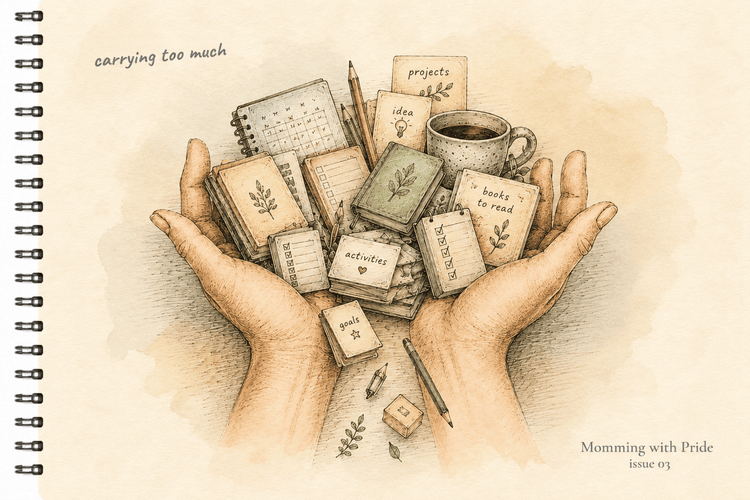
It happens in the decisions. The research. The comparisons. The planning. The constant thinking.
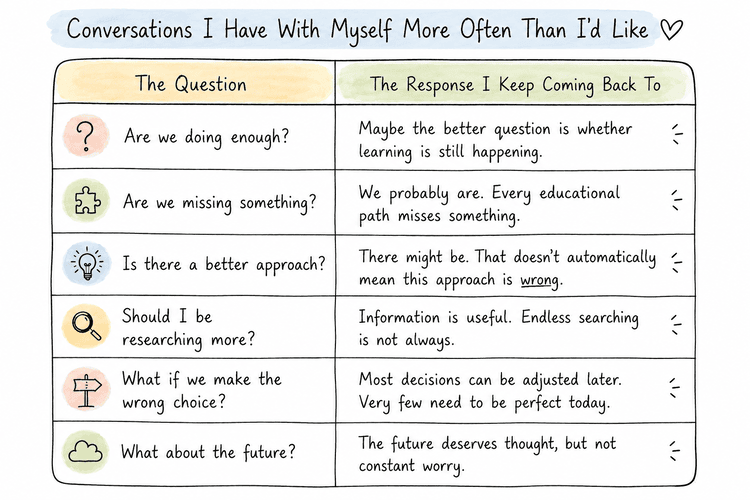
What curriculum should we use? Are we covering enough? Should we change something? Are we missing an opportunity? Is there a better approach?
Most of this work is invisible. No one sees it.
There are no completed worksheets to show for it. No finished projects. No obvious signs of progress.
Yet it occupies a surprising amount of mental space.
For me, one of the biggest surprises of homeschooling has been discovering that the mental work can sometimes feel heavier than the teaching itself.
When every decision belongs to you
One thing that changes when you begin homeschooling is the number of decisions that suddenly become yours.
In a traditional educational path, many choices are already made by someone else. Schools select the curriculum. Teachers determine the pace. Assessments follow a predefined structure. Parents may add supplementary resources, but the core framework is largely in place.
Homeschooling feels very different.
The freedom is wonderful.
But freedom also comes with responsibility.
And responsibility comes with decisions.
Lots of them.
Some are small. Others feel surprisingly significant.
What should we focus on this year? Which books should we buy? How much structure do we need? Should we follow one curriculum or combine several? How do we balance academics with childhood?
Many of these questions have multiple reasonable answers.
That is both the beauty and the challenge.
When good intentions become heavy
I don’t think most homeschooling parents spend hours researching because they enjoy making life complicated.
I think we do it because we care.
We want thoughtful learning experiences. We want meaningful opportunities. We want to support our children as well as we can.
The problem is not the intention.
The problem is what sometimes happens because of that intention.
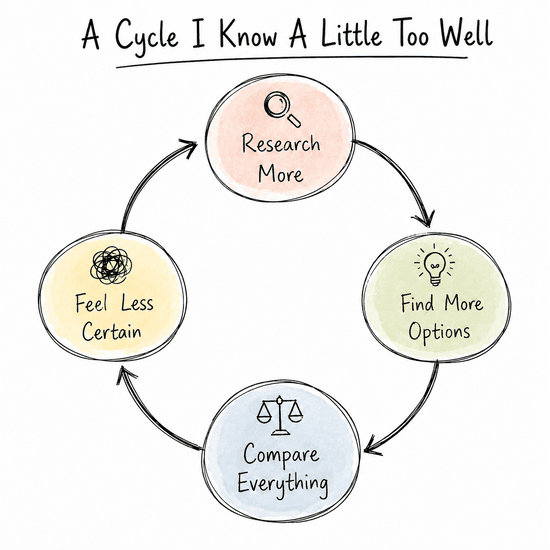
I remember opening my laptop one evening to look for a phonics resource. It seemed like a simple task. Instead, I found myself comparing different programmes, reading reviews, watching videos, saving recommendations, opening new tabs and trying to understand which option would be the best fit.
At some point, I realised I had gathered far more information than I needed. And yet I felt less certain than when I started.
The same thing happened when I explored different curricula. CBSE. Cambridge. British programmes. Alternative approaches. Resource lists. Recommendations from other homeschooling families.
Each option seemed to offer something valuable.
Each review introduced another possibility worth considering.
The challenge was never finding resources.
The challenge was deciding when to stop looking.
The weight of endless possibilities
At first, having so many options felt exciting.
It felt like a privilege.
And in many ways, it is.
But over time, I started noticing something else.
Every recommendation led to another recommendation. Every curriculum review introduced three more options. Every conversation revealed another resource I had never considered before.
The abundance itself became exhausting.
The question was no longer: “Are there enough resources available?”
The question became: “How can I ever know if I have chosen the right ones?”
Behind that question was a familiar desire.
The desire to give my daughter the best possible opportunities. The best books. The best experiences. The best learning environment.
But the longer I homeschool, the more I realise that there will always be another excellent book, another interesting curriculum, another opportunity that we cannot possibly include.
No child needs everything. No family can do everything. Every choice automatically means letting go of countless other possibilities.
Understanding that sounds simple. Accepting it has taken longer.
A gentle reminder to myself
More information does not always create more clarity. Sometimes it creates more possibilities, which can make the next decision feel even heavier.
There are moments when stepping away from the search is its own kind of progress.
Confidence and questions can exist together
For a long time, I assumed confidence and doubt were opposites.
I thought confidence meant reaching a point where the questions disappeared.
But homeschooling has changed the way I think about that.
I am confident in our decision to homeschool.
I have seen my daughter grow. I have seen her curiosity deepen. I have seen learning happen in ways I never expected.
The overall direction feels right for our family.
And yet questions still appear.
Sometimes they arrive quietly. Sometimes they appear after reading about another family’s approach. Sometimes they show up unexpectedly while planning the next few months.
The questions themselves are familiar. Most homeschooling parents know what they sound like.
What surprised me was realising that these questions do not necessarily mean something is wrong. They do not automatically signal a lack of confidence. In many cases, they come from the same place that confidence comes from.
Care. Responsibility. Thoughtfulness. The desire to make good decisions for a child we love deeply.
Over time, I have stopped viewing confidence as the absence of questions.
Instead, I have started seeing it as the ability to continue moving forward even while some questions remain unanswered.
Both can exist at the same time. And often they do.
When progress pauses
The weeks that don’t go as planned
One thing homeschooling has taught me is that learning still exists inside real life. And real life rarely follows a predictable schedule.
There are weeks when someone falls ill. Weeks when guests arrive unexpectedly. Festival seasons. Family responsibilities. Travel. Days when everyone is simply tired.
In those moments, the carefully planned rhythm of the homeschool naturally becomes lighter.
Lessons are postponed. Projects pause. The routine changes.
What surprised me was not the interruption itself. It was how quickly I started feeling responsible for it.
A family visit, a festival, or a week that felt unusually busy could leave me with a quiet sense that we were somehow falling behind.
Even when the interruption was completely reasonable. Even when nothing was actually wrong.
The pause itself wasn’t the difficult part.
The difficult part was carrying the pause.
Why those weeks feel heavier than they should
Over time, I realised that much of the heaviness came from the story I was telling myself.
That learning had stopped.
That we should be doing more.
That I needed to compensate for lost time.
But when I looked more closely, I often found that learning was still happening.
Just not in the way I had originally planned.
And that distinction started changing how I viewed those slower periods.
Learning doesn’t always look academic
This may be one of the simplest lessons homeschooling has taught me.
Not all learning happens at a desk. Not all progress arrives through a workbook. Not all growth is visible immediately.
Children learn while helping in the kitchen. While listening to family conversations. While spending time with grandparents. While navigating social situations. While observing how adults solve problems. While adapting to changes in routine.
Some of these experiences never appear on a lesson plan.
Yet they still shape a child’s understanding of the world.
Realising this has gradually changed the way I think about progress itself. I wrote more about that shift in How Homeschooling Changed the Way I Measure Progress.
I used to view paused weeks mainly through the lens of unfinished academic work. Now I find myself noticing different forms of learning as well.
That shift has not eliminated the feeling of responsibility. But it has made those interruptions feel less like failure and more like part of life.
From my homeschooling notebook
If learning is happening, relationships are healthy, and curiosity is still alive, not every unanswered question needs solving today.
Some answers arrive with experience.
What helped lighten the mental load
The mental load has not disappeared completely.
I don’t think it ever will.
There are still questions. Still decisions. Still moments of uncertainty.
But a few shifts have gradually made the weight easier to carry.
Accepting that every choice means saying no to something else
This was one of the hardest lessons for me.
For a long time, I approached homeschooling as if the goal was to find the perfect combination of resources.
The perfect curriculum. The perfect schedule. The perfect approach.
Eventually I realised that perfection keeps moving.
There is always another recommendation. Another book. Another programme. Another possibility.
At some point, I had to accept that choosing one path automatically meant not choosing several others.
That is not failure.
It is simply the reality of making decisions.
Not every question requires immediate action
This shift took time.
When a question appeared, I often felt compelled to solve it immediately.
Research it. Compare options. Look for answers. Make a decision.
Now I am more comfortable allowing certain questions to remain open for a while.
Not every uncertainty needs urgent attention. Some questions become clearer with time. Some resolve themselves naturally. Some turn out to be less important than they initially seemed.
Learning to leave space between a question and a response has made homeschooling feel noticeably lighter.
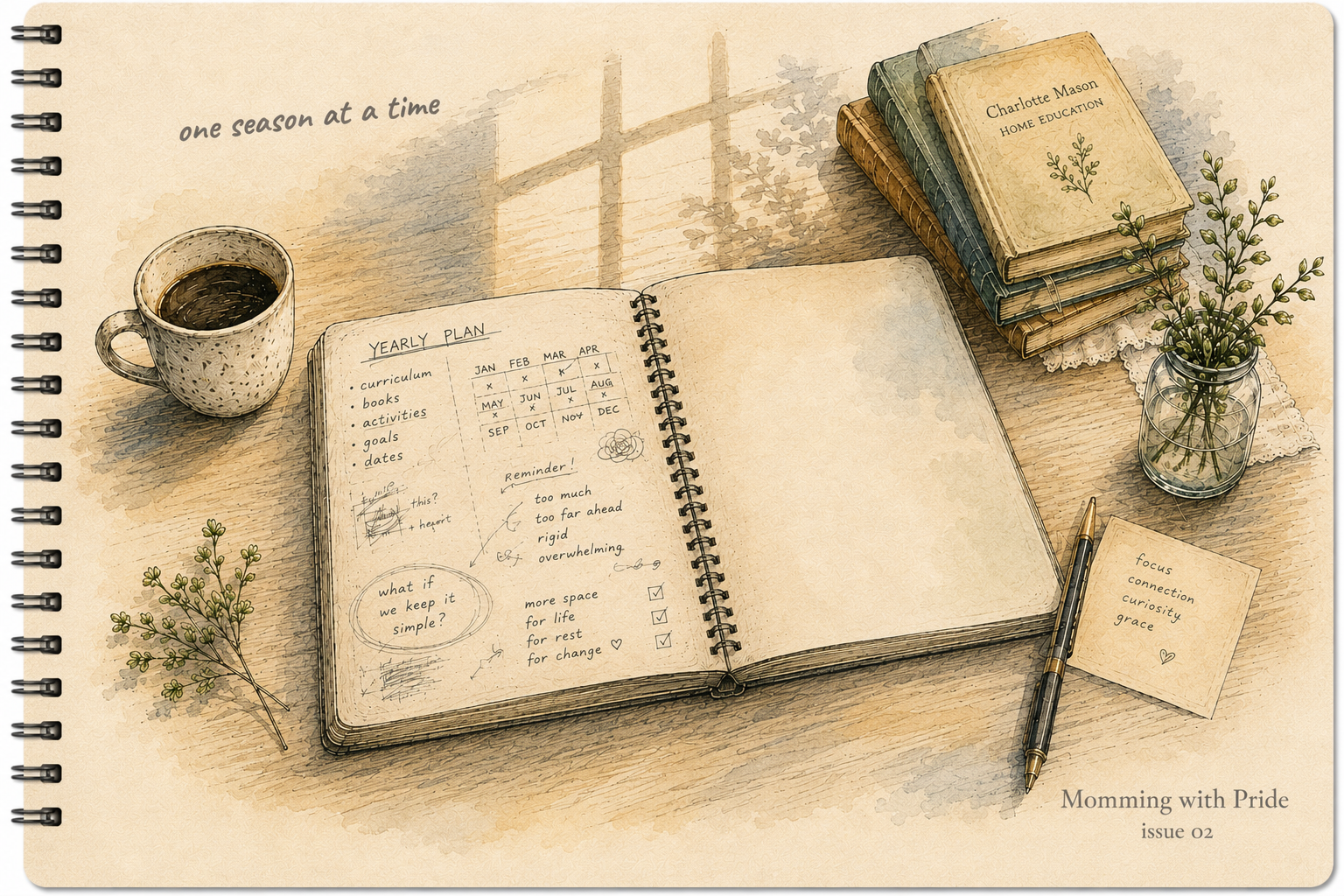
One of the shifts that helped was moving away from trying to map out an entire year in advance and focusing on shorter planning cycles instead.
Planning a few months at a time felt far less overwhelming than carrying the weight of an entire academic year. I wrote more about that transition in Why I Stopped Planning the Whole Year & Started Homeschooling in 12-Week Cycles.
Paying more attention to our home than every other home
One thing I noticed early in our homeschool journey was how easy it was to become influenced by what everyone else was doing.
A new curriculum. A beautiful schedule. An interesting activity. A successful approach.
Social media makes it possible to step inside hundreds of homeschools within a few minutes.
While that can be helpful, it can also create noise.
Over time, I have become more interested in paying attention to what is actually happening in our own home. What is working here? What is not?
What does my daughter need right now? What does our family realistically have the energy to sustain?
Those questions have become more useful than trying to keep up with every possibility I encounter online.
What homeschooling has taught me about uncertainty
Perhaps the biggest shift has been changing my relationship with uncertainty itself.
Earlier, I often treated uncertainty as a problem that needed solving.
Now I see it differently.
A certain amount of uncertainty seems to be built into homeschooling.
And honestly, into parenting as well.
The longer I homeschool, the more I realise that some questions simply cannot be solved in the present. They can be considered, prepared for, and revisited later, but not fully answered today.
No curriculum guarantees outcomes. No plan eliminates every future question. No amount of research creates complete certainty.
At some point, information reaches its limit.
After that, we continue with observation, adjustment and trust.
Not blind trust. Not certainty. Just the willingness to keep moving forward while accepting that not everything can be known in advance.
Sustainable homeschooling is more than a curriculum
When people talk about homeschooling, conversations often focus on resources. Curricula. Methods. Schedules. Learning materials.
And those things matter.
But over time, I have realised that sustainable homeschooling involves something deeper.
For me, sustainable homeschooling is one that can survive real life.
A homeschool that can adapt when plans change.
A homeschool that can recover after interruptions.
A homeschool that does not collapse because one week was unproductive.
A homeschool that allows room for uncertainty without treating it as failure.
It does not require perfect consistency. It does not require perfect planning. And it certainly does not require perfect confidence.
It simply needs enough flexibility to continue when life inevitably shifts around it.
The longer I homeschool, the more important that kind of sustainability feels.
Living with the questions
When I look back on this first year of homeschooling, one thing feels increasingly clear.
Good intentions are rarely the problem. Most of the pressure comes from caring. From wanting to make thoughtful decisions. From wanting to provide meaningful opportunities. From carrying responsibility for choices that affect someone we love deeply.
The mental load of homeschooling is not always visible. It often happens quietly. In the research. The comparisons. The planning. The questions we revisit long after everyone else has gone to sleep.
Some uncertainty will probably always remain. Some questions may never disappear completely.
But I no longer think the goal is perfect certainty. The goal is not to eliminate every question. The goal is not to find a flawless path.
The goal is to keep taking thoughtful steps forward while allowing some questions to remain unanswered.
The longer I homeschool, the more I realise that not every question needs an answer today.
Some questions are meant to be explored slowly as the journey unfolds.
And perhaps part of sustainable homeschooling is learning to carry a little uncertainty without allowing it to overshadow the learning, the relationships, and the ordinary moments that are already happening right in front of us.
Every homeschool looks a little different, and so does the way we carry the questions that come with it. If you’d like to share your own experience, I’d genuinely enjoy reading it in the comments.