CHILDHOOD & LEARNING
How Homeschooling Changed the Way I Measure Progress
Momming with Pride • Issue 04
June 2026 • 10 min read
Looking back…
There was a time during our first year of homeschooling when a disrupted routine or an unfinished lesson could leave me feeling anxious for days.
Looking back, I realize that much of that anxiety came from the way I was measuring progress.
This post is a reflection on how that changed.
It is not an argument against academics, worksheets, or structured learning. We continue to use all of those in our homeschool.
Instead, it is a reflection on the forms of learning I almost missed because I was looking too closely at the ones that were easiest to measure.
This is simply what that realization looked like in our home.
The week that felt unproductive
As an Indian mother who has been homeschooling for one year, I started this journey with a fairly simple structure. My daughter was already a little ahead of her grade level academically, so I never felt the need to fill our days with long lessons or constant worksheets.
Most days, we spent around one to two hours on focused academic work. The rest of the day was left open for books, conversations, activities, drawing, pretend play, and simply being a child.
For a while, this worked well for us.
Then there were weeks when life interrupted that rhythm. A missed lesson became several missed lessons. A disrupted day stretched into a disrupted week. Our planned academic time became inconsistent, and I found myself growing increasingly uncomfortable.
What surprised me was not the interruption itself. It was my reaction to it.
Even though I had consciously stepped away from a traditional schooling path, I still seemed to measure learning through focused academic work. When that work didn’t happen, I felt anxious. I felt guilty. At times, I even questioned my decision to homeschool.
I can see that much of that anxiety came from the invisible pressure I was carrying as a homeschooling parent. I wrote more about that experience in When Good Intentions Turn Heavy: The Invisible Mental Load of Homeschooling.
Looking back, I think many homeschooling parents experience some version of this, especially in the early stages of their homeschool journey. We may change the structure, the curriculum, or the routine. But changing the way we think about learning often takes much longer.
What I thought progress looked like
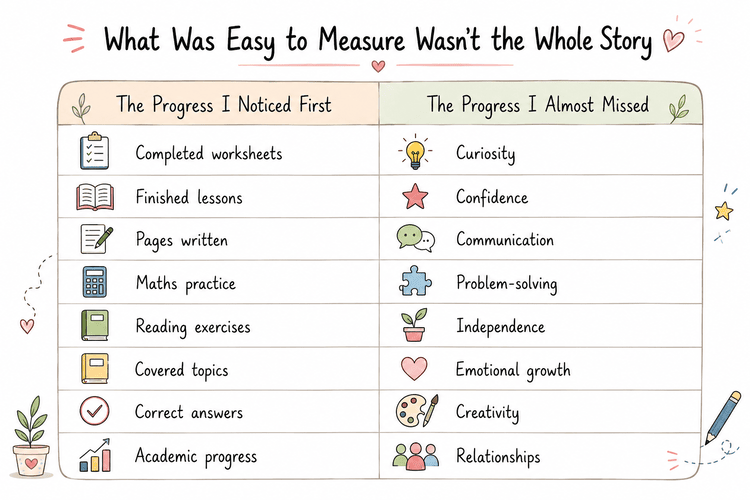
When I think about it now, the signs of progress I looked for were mostly the ones I could easily see.
A completed worksheet.
A finished lesson.
A reading exercise done well.
A page filled with handwriting practice.
These things felt reassuring because they were visible. They gave me something concrete to point to and say, “Yes, learning happened today.”
Even after choosing homeschooling, I carried many of those measures with me. I had moved away from the traditional school system, but I had not completely moved away from the idea that learning should look a certain way. It should happen at a desk. It should produce something measurable. It should leave behind evidence.
So when our academic routine became inconsistent, I automatically assumed that progress had slowed down too.
Looking back, I can understand why. Most of us have spent years seeing learning through this lens. Whether our children attend school or learn at home, it is easy to associate progress with completed work, covered topics, and visible outcomes.
The problem was not that these things mattered. They still do.
The problem was that I had started treating them as the only signs of learning. And because of that, I was missing a large part of what was actually happening right in front of me.
What I was missing
The interesting thing is that nothing had really changed about my daughter during those weeks.
She was still reading books.
She was still asking questions.
She was still spending hours immersed in pretend play.
She was still noticing things, making connections, and talking endlessly about her ideas.
The change was happening in me.
I was so focused on what was not happening that I stopped noticing what was.
Because our formal academic time had reduced, I assumed learning had reduced too. But when I started paying closer attention, that assumption began to fall apart.
I realized that I had been asking the wrong question.
Instead of asking, “How many lessons did we finish this week?” I began asking, “What did my daughter actually do, notice, explore, and learn this week?”
The answers looked very different.
Some of them did not fit neatly into a planner or a progress tracker. Some of them would never appear in a worksheet or assessment. Yet they were real all the same.
That was when I started to understand something that seems obvious now but took me time to see.
What paused during those weeks was academics.
Learning never paused.
Learning beyond worksheets
The learning hidden in everyday moments
Once I stopped looking only for completed lessons and academic output, I began noticing learning in places where I had never thought to look before.
During pretend play, my daughter would gather her dolls and teach them phonics. She would sound out words, ask them questions, and patiently explain things as though she were a teacher herself.
She spent time reading books simply because she wanted to. She asked Alexa questions about things that caught her attention. Sometimes our conversations would continue for half an hour because one question led to another.
Then there was play.
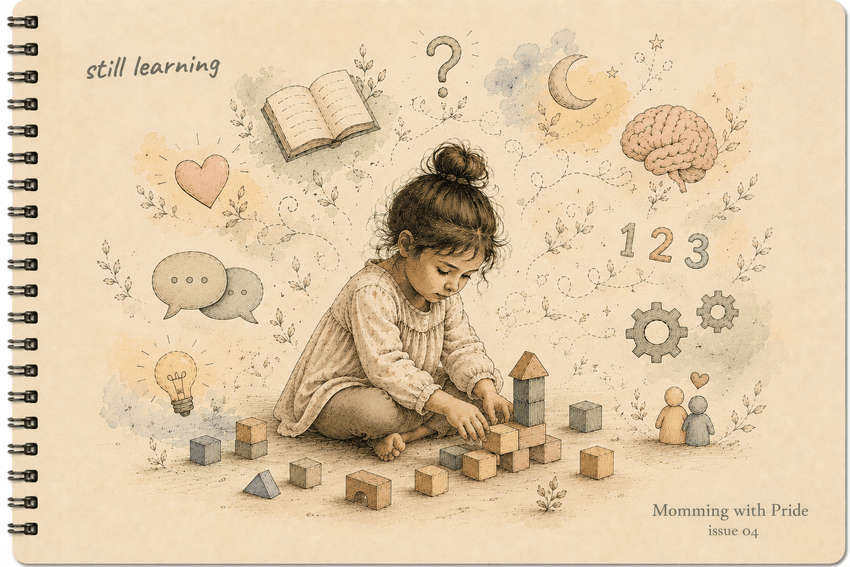
The same set of blocks could become a park one day, a waterpark the next, and a supermarket a few days later. Watching her transform familiar objects into entirely different worlds reminded me how much thinking, planning, creativity, and problem-solving can happen during what appears to be “just play.”
None of this was part of our academic schedule.
Yet learning was happening everywhere.
The questions we never planned for
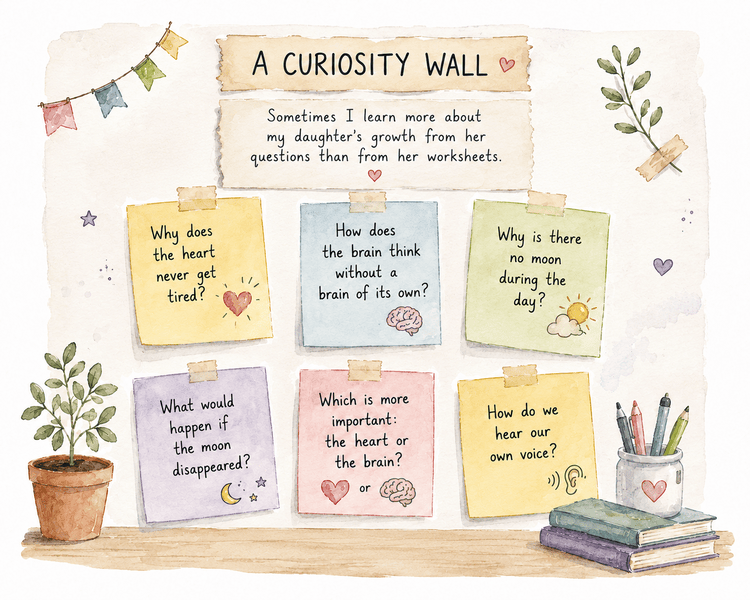
Some of the most memorable learning moments began with questions that were never part of any lesson plan.
One day she asked how the brain thinks.
Another day she wanted to know why the heart never rests.
That led to a discussion about how the heart works, which eventually turned into a debate about whether the heart or the brain is more important.
On another occasion, she wondered what would happen if the moon suddenly disappeared.
The interesting thing was not finding the answers.
It was watching how one question naturally led to another.
In a more structured setting, some of these conversations might have been postponed until a later grade or considered outside the scope of what a child her age was expected to learn.
At home, we simply followed the curiosity wherever it went.
Those moments reminded me that children do not separate learning into subjects as neatly as adults often do. A single question can touch science, language, critical thinking, and imagination all at once.
The surprises I didn’t expect
One of the biggest surprises for me has been mathematics.
I have always considered academics important, but I never wanted maths to become something my daughter feared or avoided. During her primary years, I intentionally kept our formal academic work fairly light.
Yet over time, maths became something she genuinely enjoyed.
Today, one of our favourite bedtime routines is solving a few maths problems verbally. What fascinates me is not the answer itself but the way she arrives at it.
Sometimes she solves addition and subtraction problems mentally using methods that never occurred to me. At other times, she explains her thinking in a way that makes complete sense, even though it is very different from the approach I would have used.
We have not formally introduced every concept she experiments with. Some ideas seem to emerge naturally through curiosity, observation, and repeated exploration.
What surprised me most was not her ability to solve problems.
It was her willingness to engage with them.
There is no fear. No resistance. No feeling that maths is something to avoid.
For me, that has become a form of progress too.
Not because it appears on a worksheet, but because it reflects a healthy and confident relationship with learning itself.
A different way of looking at progress
Over the past year, homeschooling has gradually changed the way I think about progress.
In the beginning, I mostly noticed the things that were easy to measure. How many lessons we completed. Whether a worksheet was finished. How much reading, writing, or maths practice we had managed to do that week.
Those things still matter to me.
I want my daughter to develop strong academic foundations. I want her to read well, write clearly, and become comfortable with numbers. Academic learning remains an important part of our homeschool journey.
What has changed is that I no longer see it as the whole picture.
Today, when I think about progress, I also pay attention to the questions she asks. I notice how she explains her ideas and communicates with others. I notice how she approaches a problem when she does not immediately know the answer.
I pay attention to how she handles disappointment when things do not go her way. How she negotiates during play. How she builds friendships. How she takes responsibility for small tasks. How independent she is becoming in everyday situations.
None of these things can be measured as neatly as a completed workbook page.
Yet they matter just as much.
In many ways, they are the skills she will carry into every area of her life, whether academic or otherwise.
This shift did not happen overnight. It came slowly through observation, experience, and a few uncomfortable weeks that forced me to question my assumptions.
Looking back, I think homeschooling changed more than my daughter’s learning environment.
It changed the lens through which I see her growth.
From my homeschooling notebook
Perhaps one of the quiet gifts of homeschooling is that it doesn’t just change how children learn. Sometimes, it changes how we learn to see them.
The signs of growth I pay attention to now
Even now, there are weeks when our plans do not unfold the way I imagined. A lesson gets postponed. A routine gets interrupted. Academic work moves more slowly than expected.
On those days, I still catch myself looking for the familiar signs of progress.
Old habits take time to change.
But I have learned to look a little wider.
I still notice reading, writing, and maths. At the same time, I notice the questions my daughter asks without being prompted. I notice her curiosity, her confidence, and the way she approaches unfamiliar situations. I notice how she communicates, solves problems, manages emotions, and connects with other people.
These things rarely appear in worksheets, assessments, or progress trackers.
Yet they tell me a great deal about who she is becoming.
Perhaps that has been one of the most meaningful lessons of our homeschool journey so far.
Progress is not always found in what a child can produce on paper.
Sometimes it appears quietly in the conversations, questions, ideas, and everyday moments that are easy to overlook if we are not paying attention.
If you’re in a season where progress feels difficult to measure, I hope this gentle reminder helps: not all learning arrives in a worksheet, and not all growth asks to be measured.
The more time I spend homeschooling, the less interested I become in measuring every step. These days, I find myself paying closer attention to the child who is growing through them.