CHILDHOOD & LEARNING
Why Children Don’t Learn in Straight Lines (and Why That’s Normal)
Momming with Pride • Issue 05
June 2026 • 20 min read
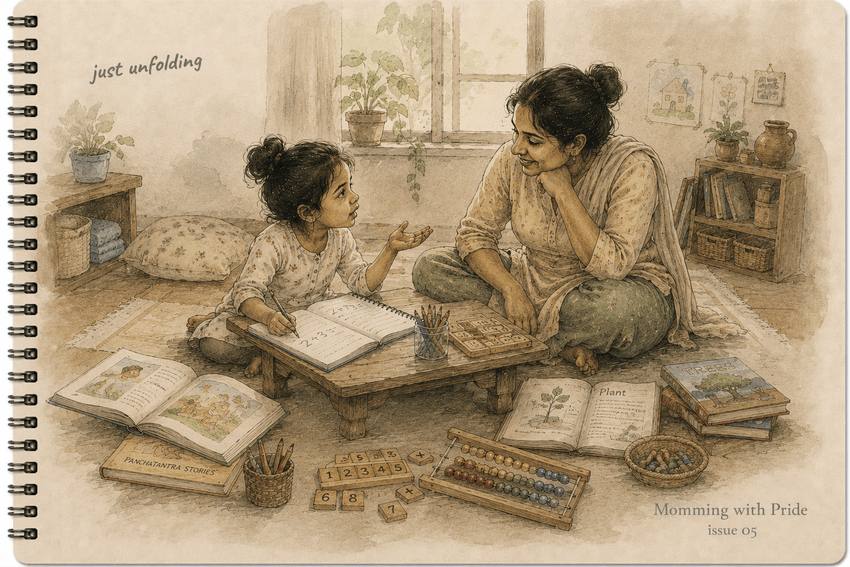
Why I wanted to write about this…
Homeschooling has made me notice something I still don’t fully know how to explain.
Learning doesn’t move the way I thought it would.
Some days it feels clear. Other days, nothing seems to make sense on the surface — even though I know something is still happening underneath.
I used to look for steady progress. Small, visible steps. A straight line.
But what I see instead are sudden jumps… and long quiet stretches in between.
And I keep finding myself stuck between two ways of seeing it — trying to name what’s happening, and simply observing it without forcing meaning too quickly.
This is a reflection on that gap: between how we expect learning to look, and how it actually unfolds in real life.
Why we expect learning to be linear
The shape we grow up with
Most of us grow up seeing learning as something that moves in a straight, structured path. In school, it is organised step by step — one class after another, one chapter leading to the next, one exam marking completion before moving forward. Progress feels visible, measurable, and clearly staged.
Without realising it, we internalise this shape. Learning begins to feel like something that should move upward in a steady, predictable line.
Why linear progress feels “safe”
There is comfort in a straight path. It creates a sense of clarity and control. When progress looks steady, it becomes easier to understand where a child is and where they are heading.
As parents especially, this clarity feels reassuring. If improvement is consistent, it feels like things are working. There is less uncertainty and less second-guessing.
A linear path also makes learning easier to explain — to ourselves and to others. It fits neatly into conversation: what a child knows, what they have achieved, what comes next. It feels orderly, even when real learning may not be.
Where confusion begins
Confusion often begins when real children don’t follow this neat pattern.
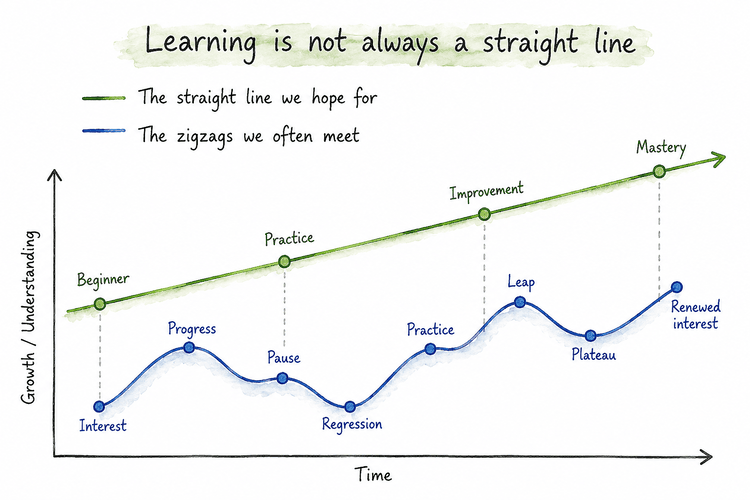
Some learning appears suddenly, without visible buildup. At other times, a skill that seemed secure becomes unstable again. A child may show strong understanding in one moment and struggle with simple tasks in the next. Progress can look uneven across areas — strong in one, resistant in another.
This is where the idea of a straight line starts to feel incomplete. Real learning does not always move forward evenly. It shifts, pauses, returns, and grows in ways that are not immediately visible.
Slowly, it becomes harder to fit what we observe into the shape we once expected learning to take.
What uneven learning can actually look like
Learning is made of multiple parallel processes
One thing we often miss when thinking about learning is that it is not a single process moving in one line. It is made up of multiple abilities developing at the same time.
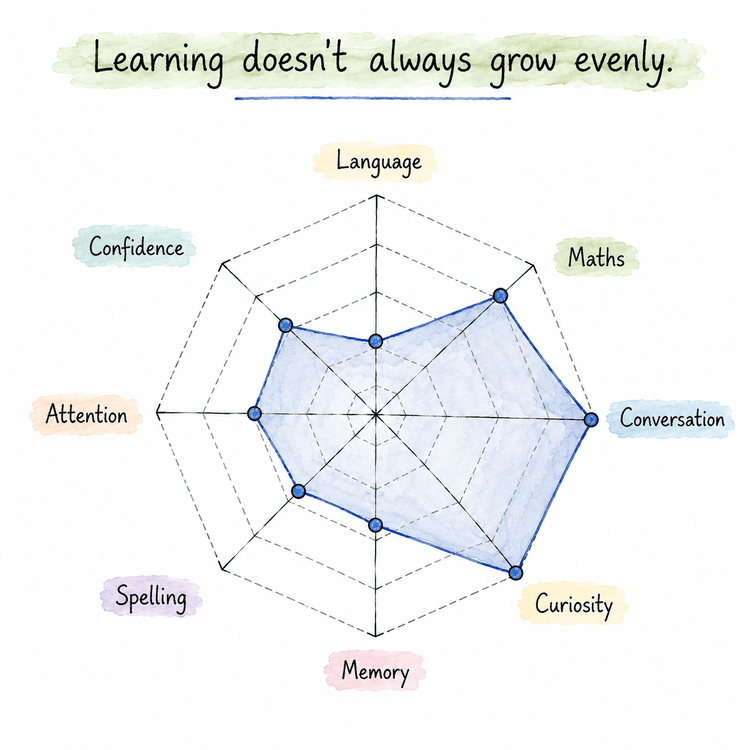
Language, number sense, memory, attention, coordination, and reasoning do not grow at the same pace. They are connected, but each follows its own timeline. Some develop earlier through exposure and familiarity, while others take longer to settle even after repeated practice.
What we usually call “learning” is actually a combination of these internal processes working together. At any point, some are more visible, while others are still forming in the background.
Because these systems are not synchronised, learning can look uneven from the outside. One area may appear strong while another seems slower, not because something is wrong, but because they are simply moving at different speeds.
This is why learning can feel uneven without being incomplete. It is not one straight line rising steadily, but multiple overlapping processes unfolding at once.
Children are changing while they are learning
Another thing I have begun to notice is that children are not learning separately from their development. They are changing at the same time. Their thinking, attention, emotions, and interests keep shifting, and this affects how learning appears.
A child at four is not the same learner at four and a half. Even small changes in language, confidence, or attention can change how they engage with the same task. Some days they seem capable of handling complex ideas. On other days, even simple things feel difficult or uninteresting.
In our experience, this shift is very visible. There are moments when my daughter asks deep, thoughtful questions about topics like the human body, or shows curiosity that feels advanced for her age. And then there are times when she resists simple concepts or loses interest quickly in things she once enjoyed.
This has made me realise that learning is always happening alongside internal change. What looks like inconsistency is often just development unfolding on multiple levels at once — not just academic, but emotional and cognitive too.
What uneven learning has looked like in our home
In our home, uneven learning has been very real, and sometimes hard to interpret day to day.
There was a phase when reading progressed quickly. My daughter was reading fluently at around four, and language development felt steady for a while. Then the visible progress slowed. It did not feel like regression, but more like a long pause where nothing obvious was changing.
Around the same time, mathematics started to behave differently. Some days she could solve multiplication problems that felt advanced for her age. On other days, she would forget very simple subtraction. These shifts could happen within short periods, which made it difficult to understand what was stable and what was still forming.
Her use of language also feels inconsistent from the outside. At times, she uses words in conversation with surprising maturity. At other times, familiar spellings or simple words do not come easily. This contrast initially confused me, because it did not match the idea I had of how learning should progress.
What stands out most is how much she learns through talking. She asks constant questions, explores ideas in long conversations, and builds understanding through dialogue rather than repetition. It often feels like thinking becomes visible only when she speaks.
When I look at all of this together, learning at home does not feel like a straight or steady line. It feels uneven, sometimes contradictory, and often only makes sense when seen over longer stretches of time rather than in daily snapshots.
A quiet pause
Maybe children are not moving slowly.
Maybe they are moving deeply.
Learning depends on many things besides teaching
When I began observing learning more closely, I started noticing that teaching is only one part of what shapes it. Many other quiet factors seem to influence how a child responds on a given day. These are not always visible, but they still affect how learning unfolds in everyday life.
Energy levels, daily routine, and attention spans in children
There are days when everything feels easier, and other days when even familiar things feel slightly out of reach. I have noticed how closely this connects to simple factors like sleep, energy, and the rhythm of the day.
On unsettled or physically active days, attention shifts quickly. On calmer days, she can sit with ideas or activities for longer. The same task can feel completely different depending on her internal state.
It feels less like a change in ability and more like a change in available mental space for focus.
Emotional state, confidence, and willingness to engage
Learning also seems closely linked to emotional comfort. There are moments when she approaches a task with ease, and other times when the same task feels heavier or less inviting.
Sometimes it is not about understanding, but about readiness to engage. When there is hesitation, even simple steps may be avoided. On other days, she may attempt more complex work without any resistance.
Confidence shifts quietly and does not always follow success or difficulty in a predictable way. A small emotional shift can change how an activity is approached, even when understanding is already there.
Changing interests and learning direction shifts in childhood
Her interests also change often. Some topics stay for a while and then fade into the background, while others suddenly become central.
English reading was once the focus. Now mathematics feels more active. At the same time, there are long conversations about topics like the human body, how things work, and abstract ideas she keeps returning to.
It does not feel like moving away from learning, but rather like learning changing direction based on what naturally holds attention at a given time.
This has made it clearer that learning is shaped not only by what is taught, but also by what a child is ready to engage with in that moment.
Learning often happens underground
One of the hardest parts of homeschooling for me has been learning to stay comfortable with progress I cannot immediately see.
I used to assume that if learning is happening, it should show clear evidence. A child should read more fluently, answer with more confidence, remember what was practised, or show visible improvement. When those signs are missing, it is easy to wonder whether learning has slowed down or paused.
But over time, I have begun to feel that much of learning happens long before it becomes visible.
Children spend a surprising amount of time observing, listening, connecting ideas, and sitting with experiences. They hear the same stories again and again, notice patterns in conversation, ask unexpected questions, and revisit ideas in their own way. Most of this does not look like measurable progress in the moment.
I remember a phase when I was unsure whether my daughter was truly reading or simply recognising familiar patterns. For a while, it was difficult to tell. Then slowly, I began noticing her using those words naturally in conversation and applying them in contexts I had not explicitly taught. It made me realise that understanding often develops quietly before it appears in expression.
I see the same pattern in how she talks through ideas. She returns to the same questions, revisits topics weeks later, and makes connections that were not obvious at the time. Looking back, many of these moments no longer feel like sudden progress, but the visible surface of something that had been developing for a while.
Perhaps learning is not always like climbing a staircase where each step is visible as we take it. Sometimes it feels more like planting something and only realising later that it has already started to grow.
From my homeschooling notebook
Learning often changes shape before it becomes visible.
Sometimes we are simply looking for it in the wrong place.
What research says about learning patterns
I am still learning about many of these ideas myself, and I do not think research can fully explain what happens in every child or every home. But reading about how children learn has helped me soften some of my interpretations. It has made me realise that many of the patterns I once found confusing are not unusual.
Progress sometimes pauses before it moves again
One idea that has stayed with me is that learning does not always move in a steady upward line. Researchers describe periods where progress appears to slow or plateau before becoming visible again.
These pauses have been observed in areas like language, music, and sports. From the outside, it can look like nothing is changing. But during these phases, learning may still be happening in less visible ways — skills are being strengthened, reorganised, or consolidated before the next noticeable shift.
This idea has helped me stop reading every quiet phase as a lack of progress.
The brain keeps working even when we cannot see it
Another idea that resonates with me is memory consolidation. Learning does not end when a lesson ends. The brain continues processing and strengthening information over time, especially through sleep, breaks, and repeated exposure.
Researchers like Robert Bjork and Judith Kroll have written about how learning can appear invisible in the moment. What looks like forgetting or inconsistency may actually be part of a longer process of building stable understanding.
This perspective feels especially real in our home, where some of the clearest signs of learning have appeared after long periods of apparent pause.
Attention and interests naturally shift over time
Work on motivation and interest has also changed how I see shifting attention. A child’s curiosity is not fixed. It moves, fades, and returns in different forms over time.
Suzanne Hidi and K. Ann Renninger’s work on interest development suggests that interest grows gradually and can change direction. Losing interest in something does not necessarily mean losing ability — it may simply reflect where attention is in that moment.
This explains why a child may be deeply absorbed in one area for a while and then shift focus entirely to something else.
Confidence influences what children are willing to show
Another layer is confidence. Researchers like Albert Bandura have shown that a child’s belief in their ability affects how they approach tasks, how they persist, and how they express what they know.
This has made me think differently about inconsistency. Sometimes, a child may understand more than they are able or willing to show on a given day. At other times, they may perform a skill confidently before it has fully stabilised.
I still do not see all of these ideas fitting neatly together. But they have made me less quick to judge what I see in a single moment. Instead, I find myself staying with uncertainty a little longer, assuming that learning may be happening in ways I cannot immediately observe.
Just a thought
Not every zigzag needs an explanation.
Some children seem to move sideways before they move ahead.
Why uneven learning feels more visible in homeschooling
Seeing learning up close
One thing I have gradually realised is that homeschooling gives a very close view of learning. We do not only see outcomes — we also see hesitation, forgotten steps, repeated questions, phases of disinterest, and moments when understanding suddenly appears.
In a classroom, these fluctuations are often less visible. Progress is usually reflected through assignments, assessments, or term-end summaries. At home, especially in a flexible rhythm, we witness more of the process itself. This can be a gift, but it also makes slow or uneven growth feel more noticeable.
I sometimes wonder whether children have always learned in uneven ways, and whether homeschooling simply makes the zigzags easier to see.
Learning without external benchmarks
Even though we have chosen homeschooling, it is not easy to completely step away from the expectations we grew up with.
In India, learning is often seen as a sequence of visible milestones — grades, textbooks, exams, and a shared timeline of progress. Without realising it, many of us internalise the idea that learning should look structured, measurable, and steadily upward.
I still notice these expectations in myself. There are moments when I want quick clarity about whether my daughter is ahead, behind, struggling, or simply in a phase. But over time, I find myself less willing to draw conclusions from short windows of observation.
What a child shows is not always what a child knows
One thing I am still learning to understand is the gap between what a child knows and what they are able or willing to show at a given moment.
Some days, my daughter surprises me with insights I did not know she had. On other days, she seems unable to recall something that felt stable just a week earlier. Over time, I have started questioning whether a single moment of performance can really represent the full picture of learning.
Perhaps learning is not only what becomes visible in the moment, but also what is quietly forming underneath.
Learning to notice growth differently
Why slow growth is so easy to miss
One of the most surprising parts of homeschooling has been how difficult it is to notice slow growth while it is happening. When we are with our children every day, we become used to their current abilities, questions, and ways of thinking. Small changes often blend into the background.
Dramatic shifts are easier to notice. A child reading a new book independently or solving a difficult problem suddenly stands out. But quieter changes — like slightly deeper questions, new connections between ideas, or more confident use of language — can easily go unnoticed.
Slow growth rarely announces itself. It usually becomes visible only in hindsight, when we look back after weeks or months and realise something has quietly shifted.
Paying attention to different signs of learning
Over time, I have begun paying attention to different kinds of signals.
I notice the questions my daughter asks and whether they are gradually becoming more connected or reflective. I notice when she returns to an idea after some time, remembers details from earlier conversations, or links concepts that seemed unrelated before.
I also listen more closely to how she expresses her thinking. Often, she understands ideas long before she can demonstrate them in a structured way. Sometimes this shows up in play, sometimes in spontaneous questions, and sometimes in the way she casually uses words that once felt unfamiliar.
None of these signs offer a neat measure of progress. They do not fit into checklists or timelines. But they remind me that learning may be unfolding in quieter, less visible ways than I once expected. And in a homeschool setting, where learning is observed closely, these small signals may matter just as much as the more obvious milestones.
Perhaps the zigzags were part of the process
I am still not sure I fully understand how my daughter learns. Some days she continues to surprise me. There are moments when she seems far ahead in one area and completely uninterested in another. There are days when I wonder if I should be seeing more visible progress, and other times when I suddenly notice that something I thought was missing had been quietly forming all along.
Maybe that uncertainty is part of being close to the learning process.
When we homeschool — especially in a way that is partly structured and partly flexible — we see almost everything. We see forgotten facts, repeated questions, abandoned interests, long conversations, sudden bursts of curiosity, and stretches where nothing seems to be changing. In the middle of all this, it is not always easy to know which moments matter and which are simply part of the flow.
I still find myself wanting learning to look tidier than it often does. A part of me still looks for steady progress and clear milestones. But I am slowly becoming more comfortable with the idea that learning may not be designed to look that way.
Maybe children are not moving in straight lines because they are not growing in just one direction. They are becoming more curious, more expressive, more capable, more confident, and more themselves — all at once, in uneven ways.
And perhaps the zigzags, pauses, and unexpected turns were never interruptions at all. Perhaps they were the process itself.
If you are homeschooling too, I would be curious to know how this looks in your own experience. There are often moments that only make sense in hindsight — after a quiet phase suddenly turns into visible change.