CHILDHOOD & LEARNING
How Emotional Safety Affects a Child’s Ability to Learn
Momming with Pride • Issue 06
June 2026 • 15 min read
Before we begin…
When we think about how emotional safety affects a child’s ability to learn, our minds often go to classrooms, teaching methods, or academic performance. At least, mine did. I believed learning depended mostly on good books, regular practice, and the right resources.
Over the past year of homeschooling, I have slowly begun to notice something I hadn’t expected. The way a child feels while learning can quietly shape their willingness to ask questions, make mistakes, stay curious, and keep trying. Sometimes, learning at home seemed to change not because I found a better method, but because the emotional atmosphere around it changed.
This post is simply a reflection from our homeschool journey. It isn’t meant to offer a formula or suggest that every family will have the same experience. It is just one observation that made me look at learning a little differently.
A conversation that made me see learning differently
My daughter has always been a talkative child. She enjoys talking to almost everyone she meets. Whether it is our house helps, an electrician working at home, a bank employee, or even a police officer we happen to see on the road, she is usually the first one to start a conversation. Her curiosity often finds its way into everyday interactions, and watching her confidently speak to people has always felt completely natural to me.
That is why I was genuinely surprised when her Kathak teacher mentioned that she hardly spoke during class.
For a moment, I thought there had been some misunderstanding.
The child I knew rarely stayed quiet for long. At home, she was expressive, asked endless questions, and happily shared her thoughts. Hearing that she remained silent in class seemed completely opposite to everything I had experienced with her.
Later that day, I gently asked her about it.
After talking for a while, she told me that she had seen her teacher scold a few students during class. Nothing had happened to her personally, but watching those moments had made her feel a little scared. She worried that if she spoke, she might say something wrong or disappoint her teacher.
That conversation stayed with me for days.
It made me realise that a child’s silence is not always a sign of shyness, disinterest, or a lack of confidence. Sometimes, it can simply be a response to how safe they feel in that moment. I found myself wondering whether emotional safety in learning influences much more than participation in a classroom. If one experience could make such a naturally talkative child choose silence, what else could fear be quietly changing before learning even begins?
Learning begins before the lesson begins
That one conversation made me think about something I had never paid much attention to before.
Until then, I had assumed that emotional safety mostly affected a child’s confidence. I thought it influenced whether children felt comfortable speaking in front of others or participating in activities. While that is certainly important, I slowly began to wonder if its role was much bigger than I had imagined.
Perhaps emotional safety affects learning long before a lesson even begins.
A child may still sit at the table, open a book, and complete a worksheet. From the outside, everything can appear perfectly normal. But inside, they may already be worrying about getting something wrong, disappointing someone, or being corrected in a way that feels uncomfortable.
Sometimes children stop asking questions before they stop learning.
Sometimes they stop trying before they stop understanding.
That doesn’t always mean they have lost interest or ability. It may simply mean they no longer feel completely free to explore, make mistakes, or express what they are thinking.
Over the past year, I have also realised that learning rarely follows the neat, predictable path I once imagined. Children often move forward, pause, revisit familiar ideas, and surprise us in ways we don’t expect. I wrote more about this in Why Children Don’t Learn in Straight Lines (and Why That’s Normal), where I reflected on how progress often becomes visible only when we stop expecting it to happen in a straight line.
As I reflected on our own homeschool journey, I began noticing that learning and self-expression often seemed to grow in the same emotional environment. When my daughter felt relaxed enough to ask questions, laugh at her mistakes, or admit that she didn’t understand something, learning usually became easier too.
This is just one observation from our home, and I know it may not look the same for every family. Still, it made me wonder whether the emotional atmosphere around learning deserves just as much attention as the lessons themselves.
A quiet pause
Sometimes learning doesn’t become difficult because the lesson is hard.
Sometimes it becomes difficult because the child no longer feels safe enough to try.
Homeschooling changed me before it changed my daughter
When we first began homeschooling, I unknowingly brought many parts of school into our home.
I made timetables, planned lessons, and tried to organise our days carefully. We had subjects to cover, activities to complete, and goals I hoped we would reach. Looking back, I don’t think there was anything wrong with wanting some structure. In fact, having a routine helped both of us settle into this new way of learning.
What I didn’t realise was that I had also carried across the pressure that often comes with it.
Somewhere in my mind, I felt responsible for making sure every lesson was completed and every concept was covered. If a day didn’t go as planned, I quietly felt that we had fallen behind. I was so focused on making learning happen that I wasn’t paying enough attention to how learning actually felt.
Then, slowly, a question began to stay with me.
What’s the point of homeschooling if the environment feels the same?
If learning still felt rushed, if mistakes still created pressure, and if finishing the lesson remained more important than enjoying the process, had we really changed anything?
I didn’t find an answer overnight.
Instead, that question slowly changed the way I approached our days. I became less concerned with controlling every part of learning and more interested in observing my daughter. I started noticing when she was naturally curious, when she needed a break, when she wanted to explore something more deeply, and when she simply wasn’t ready yet.
Some days this approach worked beautifully.
Other days, it didn’t.
There are still mornings when our plans fall apart, negotiations seem endless, or I wonder whether we have done enough. Homeschooling has not become easier simply because my perspective changed.
But over time, I have begun to notice something reassuring. The more I stopped trying to control every learning moment, the more my daughter seemed willing to participate in it. That quiet shift has shaped our homeschool journey far more than any timetable ever did.
What learning started to look like at home
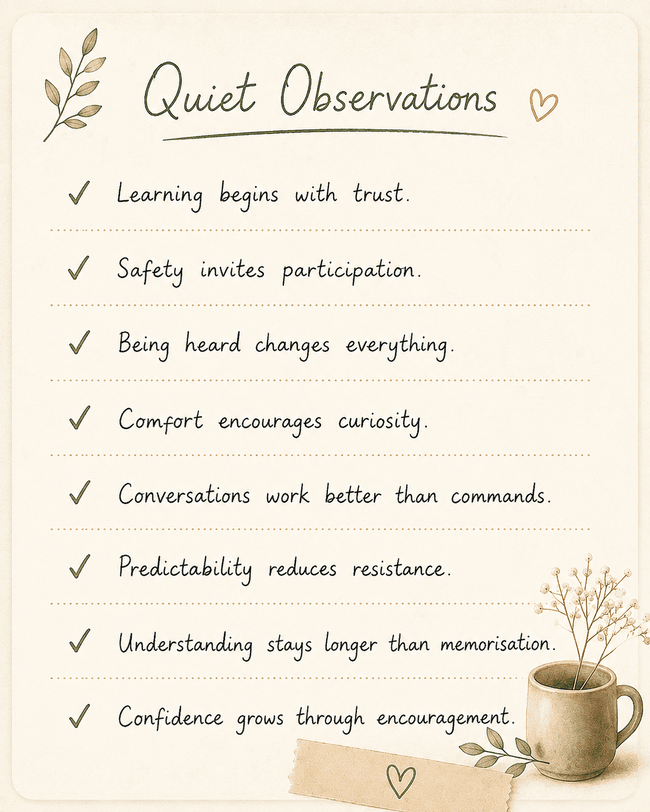
The changes in our homeschool journey didn’t happen because I found a better curriculum or discovered a new teaching method. Looking back, they came from many small moments that gradually changed the atmosphere around learning.
None of them felt remarkable at the time.
Together, they slowly changed how our days felt.
Planning our day together
One of the first things that helped was planning the day together instead of simply telling my daughter what came next.
Children, just like adults, often feel more comfortable when they know what to expect. We would talk about the day’s activities, decide the order together whenever possible, and discuss anything she was especially looking forward to or wanted to finish first.
It didn’t remove every disagreement, but it reduced many of them. There was less resistance because the day no longer felt unpredictable. She wasn’t being moved from one activity to another without knowing why.
That small change made our homeschool routine feel more like something we shared than something I managed.
Understanding before memorising
I have never asked my daughter to memorise multiplication tables.
Instead, we spent time adding the same numbers again and again. Two plus two plus two slowly became three groups of two. Without formally teaching multiplication first, she began recognising the patterns herself.
With enough practice, she now remembers many multiplication facts naturally.
The interesting part is that she never sat down to memorise them.
The understanding came first. The memory followed.
A similar pattern appeared while learning to read and spell.
Whenever she asked me how to spell a word, I tried not to answer immediately. Instead, we would think through the sounds together and use the phonics rules she already knew. Sometimes she guessed correctly. Sometimes she didn’t. Either way, she was actively thinking instead of waiting for an answer.
Over time, I noticed she was relying on herself more than on me.
Making mistakes feel safe
Another quiet change happened in the way we responded to mistakes.
We still correct them. We still practise. We still try again.
But we try not to make mistakes feel like failure.
Sometimes I give her small stickers that say, “You can do better” or “One more try.” They are simple reminders that getting something wrong isn’t the end of the learning process. It is simply part of it.
I have noticed that she now attempts difficult questions with much less hesitation than she did before.
Not because she expects to get everything right.
But because she knows getting something wrong won’t change how we respond to her.
Choosing conversations over force
Perhaps the biggest change has been replacing force with conversation whenever we can.
That doesn’t mean she decides everything or that there are no boundaries. Like every family, we still have expectations, routines, and responsibilities.
But instead of saying, “Because I said so,” we usually try to explain our reasons and listen to hers as well.
Sometimes she changes her mind.
Sometimes I change mine.
Sometimes we simply understand each other a little better, even if the outcome stays the same.
Those conversations have taught me that children often cooperate more willingly when they feel heard, even when they don’t get exactly what they want.
Looking back, I don’t think learning suddenly became effortless.
We still have days when concentration disappears, plans change, or lessons take much longer than I expected.
The difference is that learning no longer feels like a constant struggle between us.
It feels more like something we are discovering together, one ordinary day at a time.
From my homeschooling notebook
The most meaningful learning doesn’t always begin with a new book.
Sometimes it begins with a different feeling.
The days that still challenge us
Reading everything I have written so far might make it sound as though our homeschool days have become calm and effortless.
They haven’t.
In many ways, we are still figuring things out.
Focus and concentration continue to be one of our biggest challenges. Some days my daughter settles into an activity quite easily. On other days, even getting started takes patience. We have been experimenting with small time challenges, turning certain tasks into little games against the clock. Sometimes it works surprisingly well. Sometimes it doesn’t make much difference at all.
Negotiations are still a regular part of our day.
There are mornings when she wants to continue building with blocks instead of opening a book. There are afternoons when I have planned one thing, but her energy is somewhere else entirely. We talk, we adjust, and occasionally we disagree. Not every discussion ends exactly the way either of us hoped.
I also lose my patience sometimes.
There are days when I raise my voice, especially when I feel tired or when the same conversation seems to happen over and over again. I wish I handled every situation calmly, but that simply isn’t true.
What has changed is what usually happens afterwards.
We talk about it.
If I have shouted unnecessarily, I apologise. If she is upset, I try to understand what she was feeling before we return to the lesson. Those conversations don’t erase difficult moments, but they remind both of us that one hard day doesn’t define our relationship or our homeschool journey.
After one year of homeschooling, I don’t think emotional safety comes from never making mistakes as a parent. At least, that hasn’t been our experience.
I think it is built slowly through many ordinary interactions—through listening, explaining, apologising when needed, and showing our children that they can still come back to us after a difficult moment. Perhaps those everyday moments teach something just as valuable as the lessons we plan.
Learning began to look different
When I first started homeschooling, I spent most of my energy thinking about what my daughter was learning.
Had we finished today’s lesson?
Was she making enough progress?
Did I have the right books and resources?
Was I doing enough?
Those questions occupied my mind almost every day.
Over time, I realised that my attention was slowly shifting somewhere else.
Instead of only noticing completed worksheets or finished chapters, I began paying more attention to the moments in between. I noticed how my daughter approached a new challenge. I noticed whether she felt comfortable asking for help or admitting she didn’t understand something. I noticed how differently she responded when she felt relaxed compared with when she felt pressured.
Without intending to, I had started observing the learning process instead of only looking at the outcome.
That change also made me a little more patient.
Not always. I still have days when I want everything to go according to plan.
But now I find it easier to pause and ask myself a different question.
“What is my daughter trying to tell me right now?”
Sometimes the answer has nothing to do with the lesson in front of us.
Sometimes she is tired.
Sometimes she is distracted.
Sometimes she simply needs a little more time.
As an Indian mother who has been homeschooling for one year, I don’t feel that I have figured homeschooling out. If anything, I have realised how much there is still to learn. Every child, every family, and every homeschool routine looks different. What has gradually worked in our home may not fit another.
This is simply one shift I have noticed in myself.
I still care about meaningful learning, good books, and steady progress. But somewhere along the way, I stopped asking only, “What did my daughter learn today?”
I also began asking, “How did learning feel for her today?”
That single question has quietly changed the way I look at almost everything we do.
Just a thought
Children may not remember every lesson.
But they often remember how learning felt.
Sometimes that feeling becomes the lesson they carry forward.
Looking back
When I think about the conversation we had after her Kathak class, I realise it was never really about dance.
It was about understanding what had changed.
My daughter hadn’t suddenly become less curious or less talkative. She hadn’t forgotten how to express herself. She had simply stopped feeling completely comfortable in that environment.
After we spoke about fear, mistakes, disappointment, and the importance of respectfully sharing our thoughts even when a situation feels uncomfortable, I slowly began noticing small changes. She hasn’t started talking as freely in class as she does everywhere else, but she is more comfortable than she was before. Every now and then, she shares something with her teacher or responds during class, and those small moments feel meaningful to me.
Perhaps what helped wasn’t one conversation alone. Maybe it was knowing that her feelings had been heard and that she didn’t have to carry those worries by herself anymore.
I also know that confidence doesn’t always return all at once. Sometimes it grows quietly, one small interaction at a time. I hope that, with more time and familiar experiences, she continues to feel a little more comfortable being herself in that classroom.
That experience has stayed with me because it changed the way I think about learning.
Over the past year, I have watched my daughter read new words, solve maths problems, ask thoughtful questions, and become more independent. Those moments make me happy, of course.
But I have also started noticing the quieter moments.
The moments when she says, “I don’t know.”
The moments when she laughs after making a mistake instead of feeling embarrassed.
The moments when she disagrees with me, asks “why,” or feels comfortable enough to tell me that something feels difficult.
Perhaps those moments are not separate from learning.
Perhaps they are part of learning.
I still believe in good books, meaningful practice, and thoughtful planning. They all have an important place in our homeschool journey. But if this past year has taught me anything, it is that learning doesn’t happen only through lessons.
It also grows through relationships.
This is simply what I have observed in our home, and I know every family’s journey will look different. But before I think about what I want my daughter to learn next, I now find myself wondering something else.
How do I want learning to feel for her?
For now, that feels like the most important question I can keep asking.
Perhaps your experience has looked different, or perhaps parts of this felt familiar. Either way, I’d love to know what emotional safety has looked like in your home. Feel free to share your thoughts in the comments.