HOMESCHOOLING & EDUCATION
Why I Stopped Planning the Whole Year & Started Homeschooling in 12-Week Cycles
Momming with Pride • Issue 02
May 2026 • 16 min read
Before we begin…
This is not a guide on how every family should plan their homeschool year.
It is simply an honest look at a learning rhythm that gradually developed in our home after I realised that my carefully planned yearly schedules were creating more pressure than clarity.
I have been homeschooling my daughter for one year now, and one thing I keep discovering is that learning rarely unfolds exactly as I expect it to.
Some weeks feel productive.
Some don’t.
Some plans work beautifully for a while and then suddenly stop fitting our reality.
This four-quarter structure is simply what our homeschool journey looks like right now. It gives us enough structure to stay intentional without feeling like we are constantly chasing unfinished plans.
Like most things in homeschooling, this may not fit every child, every parent, or every season of life.
But this is how it slowly started making sense in our home.
Why yearly homeschool planning stopped working for us
One of the hardest things for me to recognise was how deeply my own thinking had been shaped by traditional schooling.
Even after choosing homeschooling, I was still approaching learning through the same lens I had known all my life.
An academic year. Monthly targets. Weekly plans. Daily goals. Progress trackers. Completion charts.
Without even realising it, I was trying to recreate school at home.
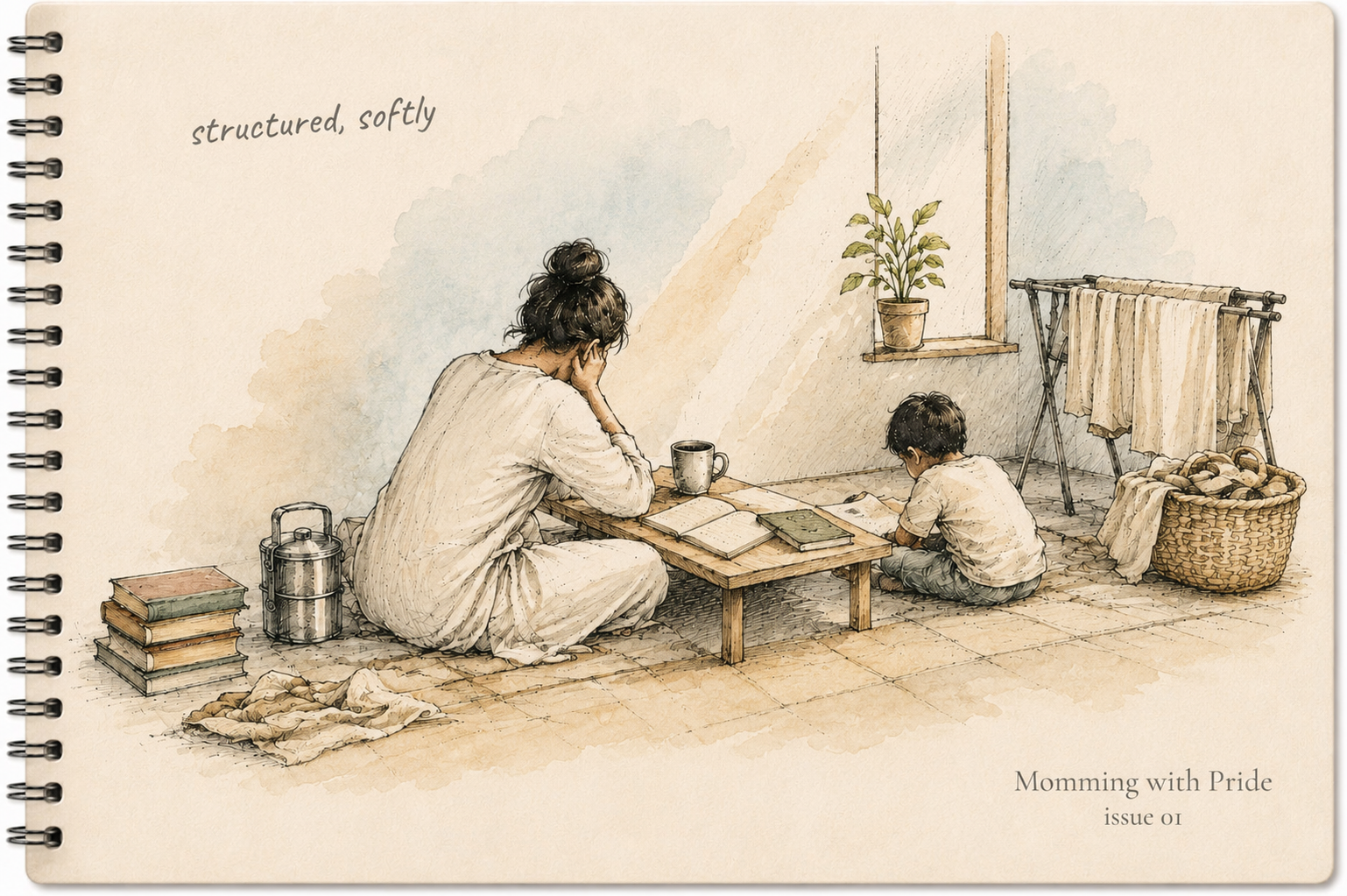
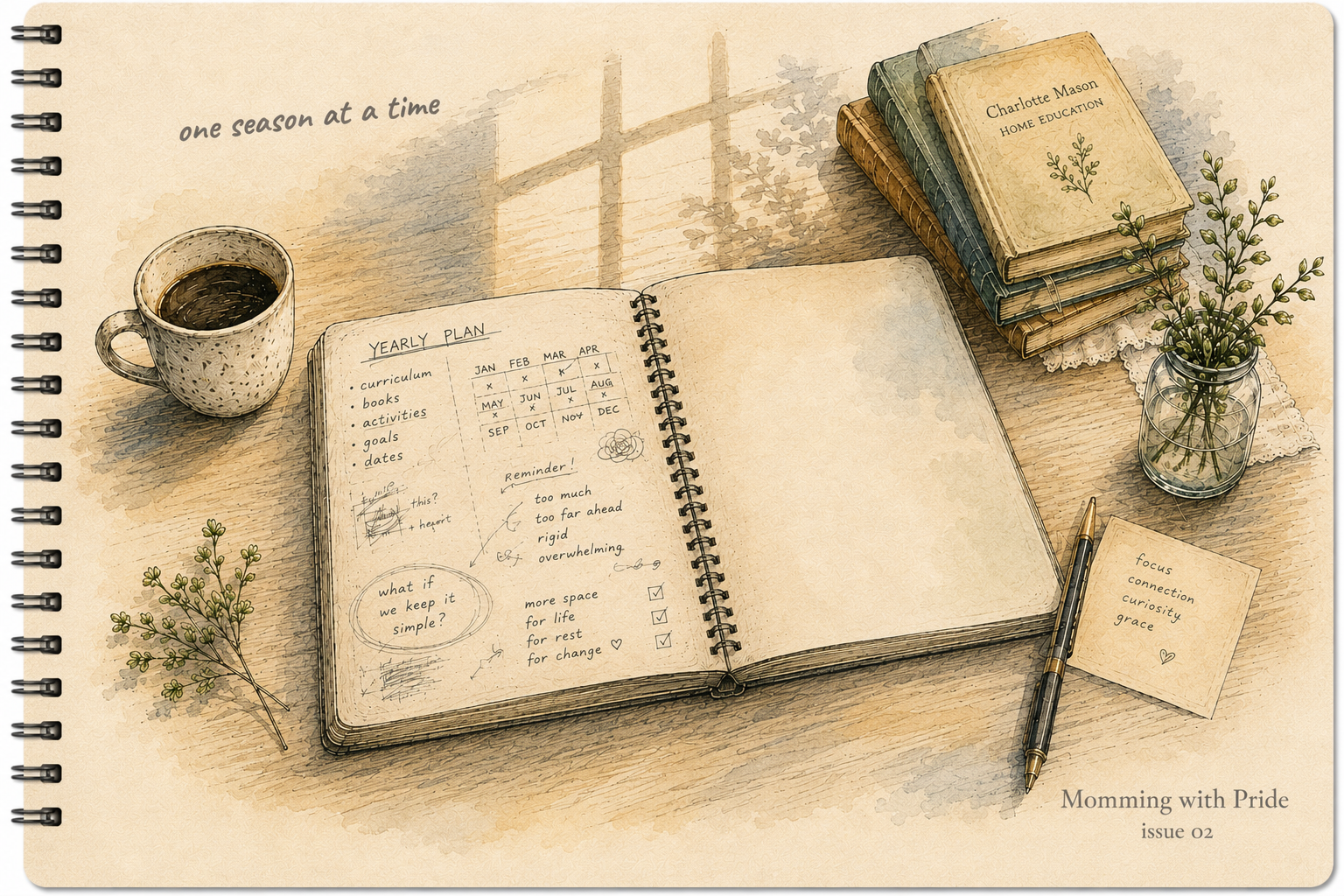
When we first started homeschooling, I spent a lot of time building a detailed yearly plan. I divided subjects into months, broke chapters into smaller goals, and created neat little schedules that looked very organised on paper.
At the time, it felt reassuring. I thought this was what responsible homeschooling looked like.
But within a few months, I started noticing small cracks.
Some subjects moved much faster than I had planned.
Sometimes my daughter understood a concept through a simple conversation long before we officially reached it in our books. Other topics needed much more time than I expected.
Some days she was full of questions and wanted to learn endlessly. Other days she had absolutely no interest in structured work.
And then there was life itself.
Festivals. Family visits. Travel. Weather changes. Unexpected illnesses. Days when everyone was simply tired.
The more I tried to stay on schedule, the more I found myself focusing on the plan instead of the learning. I was checking progress boxes without always noticing what was actually happening in front of me.
That experience also changed the way I think about progress itself. I wrote more about that shift in How Homeschooling Changed the Way I Measure Progress.
That was probably the point when something shifted.
I began realising that homeschooling works differently from school because learning at home is not limited to designated study hours.
A conversation during lunch can become a science lesson. A walk outside can become nature study. A random question before bedtime can lead to days of exploration.
Learning was already happening.
The plan simply wasn’t leaving enough room for it.
The shift from yearly planning to shorter learning cycles
I did not want to abandon structure completely.
In fact, one of the reasons I wrote my first blog post about structured homeschooling was because I genuinely value structure. If you’re curious about how I think about structure in our homeschool, you can read What Structured Homeschooling Really Looks Like in Indian Homes (Without Burnout).
I simply realised that I needed a different kind of structure.
Something flexible enough to adapt when life changed.
Something that allowed us to focus on the next few months instead of carrying the weight of an entire academic year.
Around that time, I came across the idea of planning in shorter cycles rather than planning everything twelve months in advance.
The idea immediately felt lighter.
Instead of constantly asking: “How will we cover everything this year?”
I started asking: “What deserves our attention over the next few months?”
That small shift changed a lot.
The future stopped feeling so heavy. Planning became more realistic. Adjustments became easier.
Most importantly, I found myself paying more attention to my daughter and less attention to unfinished checklists.
Why I still keep an academic-year structure
Even though I moved away from detailed yearly planning, I still loosely organise our homeschool year around the April-to-March academic cycle followed by many schools in India.
Partly because it feels familiar. Partly because it helps me organise resources. And partly because I want to leave options open in case my daughter ever chooses a different educational path later.
The academic year itself was never the problem.
The problem was expecting every month to serve the same purpose.
Over time, I started noticing that different seasons naturally supported different kinds of learning.
Some periods felt better for revision. Some felt better for introducing new ideas. Some felt better for focused academic work. And some felt better for applying learning through everyday life.
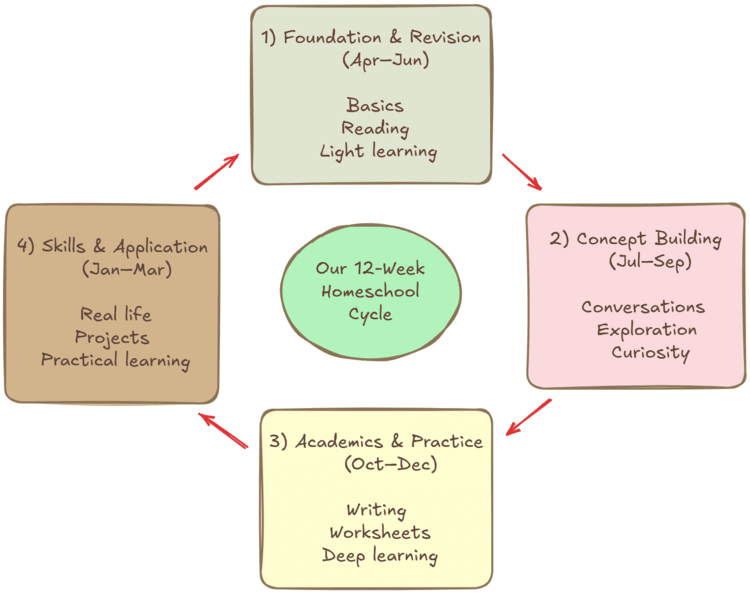
Instead of treating the entire year as one long stretch of equal intensity, I began dividing it into four learning phases.
Not because learning fits neatly into boxes. But because the rhythm helped me think more clearly.
Our four-quarter homeschool rhythm
That is how our four-quarter homeschool rhythm slowly developed:
- Foundation & Revision Quarter (April–June)
- Concept Building Quarter (July–September)
- Academic & Practice Quarter (October–December)
- Skills & Application Quarter (January–March)
The quarters often overlap. Learning does not suddenly switch from one mode to another on a particular date. Some years may look different. Some topics may move faster. Others may take longer.
But having these broad phases gives us a direction without making every day feel scheduled in advance.
And that balance has mattered more than I expected.
Quarter 1 — Foundation & revision (April–June)
Why I intentionally keep this season light
In our home, the homeschool year begins with what I think of as a foundation season.
Living in North India, April to June already feels different from the rest of the year. The weather becomes exhausting. Many schools move into vacation mode. Travel plans appear. Family routines shift. Energy levels change.
For a while, I tried pushing against that rhythm.
I thought a new academic year should begin with enthusiasm, fresh books and immediate progress.
But I slowly realised that not every season needs to begin with acceleration.
Sometimes beginning gently works better.
So instead of rushing into an entirely new syllabus, I use these months to revisit what my daughter has already learned.
Not because I am worried she has forgotten everything. More because I have noticed that learning tends to grow more naturally when new ideas have something familiar to connect to.
Revisiting before moving forward
One thing that surprised me after homeschooling was how differently I started looking at revision.
In school, revision often felt like something that happened before exams. At home, it feels more like reconnecting with previous learning.
Some concepts return quickly. Others need refreshing.
Sometimes I discover that something I assumed my daughter understood deeply was only partially understood. Other times, she remembers far more than I expected.
These months give us space to notice those things without feeling rushed.
We revisit reading. Phonics. Maths concepts. General knowledge topics. Language skills.
Sometimes the review is intentional. Sometimes it happens naturally during conversation.
The goal is not perfect mastery.
It is simply rebuilding familiarity before introducing something new.
What learning usually looks like during this quarter
At my daughter’s current age, this season looks fairly simple from the outside.
There are books, of course.
But there are also plenty of conversations.
Reading together. Maths games. Documentaries. Outdoor observations. Storytelling. Occasional worksheets.
Questions that appear unexpectedly and take us somewhere completely unrelated to the day’s plan.
Some days look structured. Some don’t. And honestly, that has become easier for me to accept.
Earlier, I often felt that learning only counted if it looked academic. Now I notice learning happening in many different forms.
Not every useful learning experience arrives in a workbook.
Why this quarter matters more than it appears to
From the outside, these months may look slow. Sometimes they even look unproductive. There are fewer visible achievements. Fewer completed chapters. Less pressure to move forward quickly.
But I have noticed that when foundations feel secure, the rest of the year becomes noticeably easier. New concepts feel less intimidating. Connections happen faster. Confidence grows more naturally.
The interesting thing is that this quarter rarely feels impressive while we are living through it. Its value usually becomes visible later.
When a new topic appears and suddenly feels familiar.
When a concept connects more easily than expected.
When previous learning quietly supports new learning.
For us, this season is less about achievement and more about preparation.
And over time, I have started appreciating that kind of progress too.
Quarter 2 — Concept building (July–September)
Why I prefer concepts before formal academics
The second quarter is usually when we begin exploring many of the new ideas we will encounter during the academic year.
But I rarely introduce them through formal lessons immediately.
This is something that changed significantly after I started homeschooling.
Earlier, I assumed learning began when we opened a textbook.
Now I often see learning beginning much earlier.
Sometimes it starts with a story.
Sometimes with a question. Sometimes with a documentary.
Sometimes with a completely random observation.
Before asking my daughter to write about something, I prefer giving her opportunities to see it, hear it, discuss it and become familiar with it first.
At least at this stage, understanding seems to grow more naturally that way.
Building familiarity before expecting performance
One thing I have noticed is that children often appear confident when a topic no longer feels completely new.
That familiarity matters.
A child who has already heard about planets, magnets, habitats or fractions through everyday exposure approaches formal learning very differently from a child encountering those ideas for the first time.
The goal during this phase is not mastery.
It is exposure.
I simply want concepts to become part of our conversations before they become part of our notebooks.
How we explore new topics
This is usually the quarter where I spend the most time gathering resources.
I look through books. Browse different curricula. Collect ideas. Save documentaries. Make notes. Think about which concepts are already familiar and which ones may need more support.
One thing I genuinely enjoy about Indian homeschooling is the freedom to pull from different places. We are not limited to a single book or board. That flexibility allows us to build something that fits our family more naturally.
The planning is still there. It just looks different from the detailed yearly schedules I used to create.
Learning often happens in unexpected ways
Many of our most memorable learning moments during this phase are not planned.
A simple question about the heart once turned into several days of books, videos and conversations about body organs. Eventually we bought a model because her curiosity continued long after the original question had been answered.
At another point, questions about sunlight gradually led us into discussions about shadows, day and night, the moon and the changing sky.
None of these topics appeared because I scheduled them on a particular date. They appeared because curiosity opened the door.
This does not mean we abandon structure. It simply means structure leaves enough room for exploration.
Why this phase changed the way I think about learning
One thing homeschooling keeps teaching me is that curiosity and academics do not have to compete with each other. For a long time, I unconsciously treated them as separate things. There was “real learning” and then there were interests. Now I see them blending together much more often.
A child’s question can become science. A news discussion can become geography. A storybook can become language learning. A family conversation can become history.
Of course, not every curiosity needs to become a full project. And not every question leads somewhere meaningful.
But I have become much more comfortable allowing some interests to grow before deciding whether they belong in a syllabus.
Sometimes the most valuable learning begins that way.
By the end of this quarter, many of the concepts we will study more formally later in the year already feel familiar.
And that familiarity changes the atmosphere of learning more than I expected.
Quarter 3 — Academic & practice (October–December)
When formal learning starts taking centre stage
By the time we reach October, something interesting has usually happened.
Many of the concepts we plan to study more formally no longer feel completely new. They have already appeared in conversations, books, documentaries, activities, questions or everyday experiences throughout the previous months.
That familiarity changes things.
Instead of introducing a concept and practising it at the same time, we are often building on something that already exists. And I have noticed that formal academics feel much lighter when children are not starting from zero.
What focused academic time looks like in our home
This is usually the quarter where books, notebooks and worksheets become a more visible part of our routine.
Reading practice becomes more intentional. Writing increases. Maths practice becomes more consistent. We spend more time strengthening skills that need repetition.
At my daughter’s current age, our focused academic work is usually around two hours a day.
Some days are longer.
Some are shorter.
Some days we cover several subjects.
Other days we spend most of our time on one area because something has captured her interest.
The routine is structured, but not rigid.
At least for now, that balance seems to work for us.
Why two hours feels different from two hours at school
When I first started homeschooling, I found it difficult to believe that meaningful academic work could happen in such a relatively short amount of time.
Like many parents, I unconsciously equated long study hours with serious learning.
But over time, I realised that focused learning time and total school time are not the same thing.
This is not a criticism of schools. Schools serve many purposes beyond academics. They manage groups of children, social interaction, activities, transitions, assessments and countless other responsibilities. Naturally, learning happens within a larger structure.
At home, our situation is different. There is immediate feedback. Less waiting. Fewer transitions. More flexibility. If my daughter understands something quickly, we move on. If she needs more time, we slow down.
The pace can respond to the learner instead of the timetable.
The part I did not expect
One thing that surprised me was how much confidence affects academic work.
When children already feel familiar with a concept, they often approach practice differently.
The work itself may not be easier. But it feels less intimidating. There is less resistance. Less hesitation. Less anxiety about getting things wrong.
I have seen this especially in maths. Sometimes my daughter approaches a new worksheet almost as if she is testing what she already knows rather than trying to learn something completely unfamiliar.
That shift has changed the atmosphere in our home far more than any schedule ever did.
Why I focus more on understanding than completion
The older I get, the less interested I am in finishing something simply because it appears on a checklist.
Of course, progress matters. Consistency matters. Practice matters.
But I have become more interested in whether understanding is actually developing.
Some topics move quickly. Some stay with us for much longer than expected. Sometimes a single concept creates weeks of questions. Sometimes an entire chapter passes without much discussion.
I no longer see that as a problem.
Learning does not always happen in neat subject-wise compartments. One conversation can involve language, science, history and critical thinking all at the same time.
So while we maintain structure, I try not to become overly attached to pace. Understanding has become a more useful measure for me than completion.
Quarter 4 — Skills & application (January–March)
When learning starts moving beyond the books
By the beginning of the final quarter, most of the year’s formal learning is already behind us.
We have revised. Explored. Practised. Strengthened.
At this point, I usually feel less interested in adding more academic intensity. Instead, I become more interested in how learning connects to real life.
This is the season where we slow down slightly and create more opportunities to use what we have learned.
Not because academics are finished. But because application often deepens understanding in ways that worksheets cannot.
What application looks like in our home
Some learning during this phase is planned. A lot of it isn’t.
Maths appears during shopping, measuring ingredients, budgeting conversations or simple everyday calculations. Science shows up through gardening, weather observations, cooking and small experiments. Language becomes part of reading, journaling, discussions and storytelling.
Sometimes we work on projects. Sometimes we simply notice how concepts appear in daily life.
The learning is often less visible than a completed workbook. But it feels more connected.
Making space for culture, identity and values
This is also the time when I consciously make more room for cultural and value-based learning.
Not as a separate subject. More as part of family life.
Living in India, children grow up surrounded by traditions, festivals, languages, stories and beliefs.
I want my daughter to understand these things with curiosity rather than simply accepting or rejecting them automatically.
We talk about why certain practices exist. Where traditions come from. How different people think about them.
Sometimes these conversations lead to history.
Sometimes philosophy.
Sometimes questions I cannot answer immediately.
And that is fine too.
I am becoming more comfortable saying, “Let’s explore that together.”
Why this phase matters
One thing I keep noticing is that children remember things differently when they actually use them. Knowledge becomes less abstract. More personal. More meaningful.
The goal is not to prove that learning happened. The goal is to let learning become part of life.
And for us, this quarter often helps bring the entire year together in a quieter way.
A small realisation
Children do not grow in a straight line. Some months are full of curiosity, some of practice, some of repetition and some of unexpected leaps.
This system simply gave us room for all of them.
What this system doesn’t solve
Reading this article from beginning to end might make the system sound more organised than it actually feels while we are living it.
The reality is much messier.
The quarters overlap. Plans change. Interests appear unexpectedly. Some topics take far longer than I anticipated. Others disappear almost as quickly as they arrived.
There are still weeks when learning feels difficult. Weeks when routines fall apart. Weeks when I question whether we are doing enough.
This structure has not removed uncertainty. It has not eliminated parental doubt. It has not made homeschooling predictable.
What it has done is give us a general direction. A way to move through the year without feeling like every month must accomplish the same thing.
And honestly, that has been enough.
What changed after we started working this way
Learning started feeling less forced
The biggest change was not academic.
It was emotional.
Learning started feeling lighter. There was less pressure around “keeping up.” Less urgency to finish things immediately.
More room for curiosity.
More room for questions.
More room for genuine interest.
I noticed my daughter reading voluntarily more often. Asking deeper questions. Following ideas beyond what was required.
The atmosphere around learning began changing long before the outcomes did.
Independence developed slowly
Another change surprised me.
As pressure reduced, independence seemed to increase. Not overnight. Not dramatically. But gradually.
Sometimes when she gets stuck on a problem, she keeps trying before asking for help. Sometimes she wants to investigate something further on her own.
I do not think this happened because of any particular strategy.
If anything, it seems to have grown naturally from feeling safe enough to try.
Childhood started feeling less rushed
Perhaps the change I value most is that our days no longer feel dominated by unfinished academic targets.
There is still structure. There are still expectations.
But there is also space for ordinary childhood experiences.
Play. Conversations. Exploration. Rest.
The days feel more balanced than they did when I was constantly measuring progress against a yearly plan.
I stopped feeling like a manager
This may have been the most unexpected change of all.
I stopped feeling like I was managing a project. Instead of constantly monitoring targets, I found myself paying more attention to my child.
Observing. Listening. Adjusting. Responding.
The shift seems small when written down. But it changed a lot in practice.
From my homeschooling notebook
Not every phase of learning needs the same intensity. Some seasons are for building foundations, some for exploration, some for practice and some simply for living what we learned.
Final thoughts
When I first started homeschooling, I assumed that good planning meant having the entire year mapped out in advance.
Now I am not so sure.
The longer I homeschool, the more I notice that learning rarely follows a straight line.
Some months are full of curiosity.
Some are full of repetition.
Some seem quiet until I suddenly realise how much has been absorbed beneath the surface.
This four-quarter rhythm has not made homeschooling easier. It has not removed uncertainty. And it certainly has not provided answers to every question.
What it has done is give our family a structure that feels flexible enough to adapt when life changes. Right now, it allows academics, curiosity, family life and rest to exist alongside each other without constantly competing for space.
That balance may look different in another home.
It may even look different in our own home a few years from now.
But at this stage of our homeschool journey, it is the rhythm that has felt most sustainable.
And for now, that feels like enough.
This is simply one way a homeschool year has slowly taken shape in our home. If your family approaches planning differently, I’d genuinely enjoy hearing what has worked for you in the comments.